I posted the Hardway Bros remix of Sparking Plugs by Deo'Jorge last week (the post is here) and at that point hadn't heard the Prins Thomas remix of the same track. Nine and a half minutes of dark, entrancing, sinuous, Scandi- disco is what I'm saying.
Prins Thomas remixes, often titled Diskomiks, are a joy- wiggy, pulsing and inventive versions. His soaring Diskomiks of Kingdom Of Rust by Doves is always a pleasure to hear as is his spaced out bouncy remix of Seahawks with Tim Burgess on vocals, there's a stunning take oo Terr's Tale Of Devotion, a very long one of Kelly Lee Owens's Bird from last year and A Man Called Adam's Paul Valery At The Disco. This one of Alpine by The Orb is very good too, a track I thought was pretty recent but is already five years old.
Heaton Park is all set up for Parklife, a two day festival across this weekend largely attended by people much younger than me. New Order took advantage of the set up and played a homecoming gig there on Friday night. Stepping outside Heaton Park's Metrolink station there's a long line of middle aged fans queueing to get to the gates where Covid passports are checked, bags are rummaged through by security, people are scanned with metal detectors and then finally QR code tickets on phones read by yet another line of security. JD Sports logos are all over the big screens either side of the stage. We arrived late, having missed both support acts (Working Men's Club and Hot Chip) but with enough time to join another long queue to get drinks. No draught beers, just bottles and cans with four cans of Carling coming in at an eye- watering £24. No wonder that so many people turned up having had their pre- gig drinks elsewhere. My unease with Covid and crowds meant we found a spot near the back- usually I'd want to be far further forward. The air is sweet with the smell of substances. The ground is not muddy despite some recent rain. A couple of men near us have a picnic blanket out. There's a chilled atmosphere but as DJ Tin Tin slips Voodoo Ray onto the sound system a palpable buzz starts to fizz through the crowd. Not long after, just as dusk hits, New Order appear.
I wasn't expecting to be as blown away as I was. Bernard welcomes us all, saying how good it is to be playing live after a shit eighteen months and then adds, 'Fuck Covid', and then they're off into Regret and without much much of a pause Age Of Consent. This is a filled out, muscular New Order, the slightly shonky, thinner sounding, almost on the verge of it all falling apart, group of the 1980s beefed up, loud and powerful. Their romp through the set takes in most of what you'd want New Order to play, the songs that you've danced to at indie nights, clubs and house parties since the mid- 80s plus a handful of newer ones. Ultraviolence, resurrected from 1984's Power, Corruption And Lies, is an early highlight, the bassline bumping and the anxiousness of Bernard's original vocal replaced by something calmer and older (inevitably). They follow it with Ceremony which causes mild mayhem around us, the ringing guitar lines and Stephen's hi- hats cutting through the decades and the masses joining in, 'This is why events unnerve me/ They find it all the same old story'. Moments like this catch you off guard, emotions suddenly bubbling up, songs you've sung for over thirty years that have become part of a shared history and people's lives. Early New Order songs feel achingly personal, the sound and the words, a response to the end of Joy Division and Ian's death, and when you hear them sung by thousands in celebration it's quite something. Your Silent Face, listed as KW1 on the band's setlist, the working title for the song back in 1983 (KW1 = The Kraftwerk One) is a joy, Bernard's melodica solo just as shaky as it ever was. A friend said elsewhere that half the attraction of New Order is when they 'nearly fall to pieces... they're never quite 100%' and I think that's exactly right. Their frailties and lack of polish still gives them an edge even if they're nowhere near as unprofessional as they used to be and have equipment that is one hundred times more reliable.
The final eight songs are a blur, one high after another. A monumental Subculture (one of their greatest moments for me), that keyboard riff hammering out and the stuttering drums crashing around Prestwich. Funnily enough the group's old rehearsal rooms are just down the road, the songs that were written and worked out in a bunker in Cheetham Hill now filling the air a mile away. As Subculture ends there's less than a moment to draw breath before the bass intro of Bizarre Love Triangle slams though the PA and we're taken yet another notch higher and then as they segue into the majestic Vanishing Point, they lift us even further- the kick drum, sequencer and those delirious guitars and keys, 'My life ain't no holiday/ I've been to the point of no return...'
As if that wasn't enough they play The Perfect Kiss next. Plastic from their last album is dedicated to Denise Johnson and then we're into the home straight and True Faith, Blue Monday and Temptation. True Faith has been one of my favourite New Order songs since it came out back in August 1987, I never tire of it- the version they paly live is housed up with piano all over the chorus. Temptation is in a class of it's own- that acidic sequencer line bringing us up and Bernard's words the sound of a million kids now grown up and a thousand nights out, 'Heaven/ A gateway/ I hope... Tonight I think I'll walk alone/ And find my soul as I go home'. We all do the whoops and sing the basslines and join in with the chorus, 'Up, down, turn around/ Please don't let me hit the ground'. The tension and release that everyone knows is coming still hits hard, one of those heart in the mouth moments, 'Oh you've got green eyes/ Oh you've got blue eyes/ Oh you've got grey eyes/ And I've never seen anyone quite like you before'.
If that was all we got I think we'd have been happy (apart from one of our party, Geoff, who shouts for Procession and in his own words 'always shouts for it but they never seem to hear'). Bernard, Gillian, Stephen, Phil and Tom re- appear for an encore and give us three Joy Division songs- a still fragile sounding Decades with Ian's face projected on the screens, a blistering Transmission and then finally Love Will Tear Us Apart- and that's it, we're done, spent, wrung out, happy.
At this point my brother's wife's cousin decides to shin up the nearest flagpole and fair play to him, fired up by Mancunian dance rock, lager and natural excitement, he gets a good way up it.
The new Saint Etienne song Pond House (released at the end of July ahead of an album called I've Been Trying To Tell You, out yesterday) is a bit of a joy. It opens with sound effects and a lazy 90s drum beat and has a slightly woozy, end- of- the- day feel, gloriously melancholic with a dubby bassline and a Natalie Imbruglia vocal sample. Despite the melancholy and nostalgia trapped within it it manages to leave you feeling better than it found you and that's quite a trick to pull off.
New Order are playing a big gig tonight at Heaton Park, North Manchester. I made a fairly late decision a week ago to take up the offer of a ticket from a friend. I was in two minds about going from the moment it was announced, firstly because I came to the conclusion a while ago that standing in a field is rarely the best way to see a band and secondly because I decided also some time ago that I'm not sure it's even New Order without Peter Hook on bass. I understand the argument and split means that he can't be in the band anymore but his playing, presence and sound are such an integral part of the New Order story, especially the glory years of 1981 through to 1990, that without him it sometimes seems more like the Bernard Sumner Experience or Bad Lieutenant plus Gillian Gilbert. But maybe that's just me.
Why did I change my mind? Firstly because their songs from the 1980s are among the most cherished music I own. Secondly because we've all been starved of gigs and live music recently and we've had to take the decision to avoid indoor events- Isaac, our eldest, is extremely vulnerable and he's at as much risk from Covid now as he was in March 2020. 'Avoid indoor and unventilated spaces, avoid crowds' is the advice we've been given. While we've all been double vaccinated we could still transmit it back to him and being in pubs, restaurants and indoor gigs are about as good a breeding ground Covid as any space as I can think of (excepting schools maybe but I have far less choice about going to one of those every day). I missed Sonic Boom at Yes last week, Will Sergeant in conversation with Dave Haslam a few nights ago and will miss ALFOS at the Golden Lion in Todmorden tomorrow night (an event a small group of us, me included, have been offered an afternoon DJ slot. Gutted does not begin to cover it). So it dawned on me that going to see New Order at Heaton Park could well be the sum total of gigs I'm able to attend between now and next summer. Standing at the edge/ near the back, away from the massed throng, should be fairly safe. And also re: Hooky etc, I thought maybe I should just lighten up.
In April 1984 New Order released a perfect 12" single, the masterpiece that is Thieves Like Us, from the heyday of Factory Records and packaged in typically obtuse but beautiful Peter Saville sleeve. On the B-side is one of the true lost gems in their back catalogue- Lonesome Tonight. Hooky's bass intro snags you immediately, instantly recognisable as him. The guitars are bright and brittle, the drumming understated but spot on- listen to that snare drum snap- and the synths are majestic and soar. Bernard sings something that sounds like he really means it, single tracked and intimate. A happy/ sad mini- epic. The lengthy instrumental end section is where Joy Division were heading (possibly) and where New Order found a way out of the hole they found themselves in in May 1980- the lyrics suggest, a loss of youth, an end of innocence. It is one of the finest things they ever released.
Two slices of late summer Balearica from the reliable hands of DJ/ producer/ musician/ journalist Chris Coco, perfect for this sweltering September heat wave. I sat in the garden last night, the sky an inky deep blue and the trees silhouetted in black against it. It was still 25 degrees centigrade, hotter than it was in August. There are some bats that flit over the garden- you catch them out of the corner of your eye as they zig zag left and right. They brighten my day up every time I half see them.
Back to the Balearica. First is Chris Coco with George Solar and their Lagrimas De San Lorenzo, a blend of spaced out synths, warm summer sounds and some jazzy guitar. Proper back garden watching the bats against the night sky in the heat music.
The Coyote remix is even better. I can't find a Youtube clip for it so you'll have to go to Bandcamp to listen to it- you can do that here. Coyote, a Notts DJ/ producer duo, have been everywhere I turn this year and an album is due out shortly. The remix slows things down, stretches it out and finds a very cool groove.
Chris and George released this recently too, a dub version of September On The Island, a tribute to Ibiza when the season has ended and the beaches are empty. Nice work if you can get it. Low slung Balearic dub with a lovely wandering trombone part. Buy it here.
I don't know what Sean Johnston has been drinking recently but it's done wonders for his productivity and the sheer quantity of Hardway Bros remixes has been matched by the quality- every single one is a keeper. This one came out two days ago, a remix of Sparking Plugs by Deo'Jorge from an EP on Newcastle- upon- Tyne's Me Me Me label. The Hardway Bros Sueno Cosmico remix sounds like a party in a rainforest, a rave in an aviary (a raviary?). Nine minutes of tropical cosmic Balearic joy. Buy it here.
Sean's remix of James Bright's Suburbia, the Hardway Bros 'ALFOS Has Risen' Remix is in part a celebration of the all night travelling roadshow he instigated with Andrew Weatherall eleven years ago, now revived single handed. The remix is a gloriously chilled dreamy dance track that teases us with hints of The Beloved's ambient house classic The Sun Rising. Buy it here.
Malcolm McLaren has been painted as the villain in the Sex Pistols story for many years, usually by John Lydon who commands more air time and print inches than the rest of the participants put together. Malcolm was instrumental in that band's story but his wider contribution to popular culture goes way beyond the filth and the fury and subsequent crash and burn. Following the demise of the Pistols he kept running, straight into Bow Wow Wow and then moved on again, faster and faster, intent on mashing together disparate elements to create something new. This led to at least two further moments of inspiration and musical alchemy.
In 1983 Malcolm put out his debut album, Duck Rock. His debut single Buffalo Girls was a genuine piece of cross cultural game changing with scratching and sampling, the World Famous Supreme Team, Zulu backing singers, Trevor Horn at the production desk, a record that was key in early hip hop culture. He followed it with Double Dutch, equally brilliant and further blurring cultural boundaries- skipping chants, a zippy bassline, hi- life guitars and South African vocals. He was sued by The Boyoyo Boys for that but a Top Three hit in the UK chart must have softened that blow.
Two years later he went further and deeper releasing an album called Fans that spliced opera with modern R & B. Madame Butterfly, a version of Puccini's famous work, a genuinely jaw- dropping piece of music- Stephen Hague now at the controls, crunching 80s synth drums, flutes, McLaren's speaking voice and hugely affecting vocals from Debbie Cole and Betty Ann White.
This version, a remix by Morales and Munzibai, stretches it out for ten minutes with a much toughened up rhythm- industrial/ hip hop drums and foregrounded metallic, slap bass and whooshing noises.
Malcolm's death in 2010 brought some correction to his story and his role in punk but there's much more to Malcolm than just the Sex store, bondage trousers and Johnny Rotten, a tale we've all heard a thousand times anyway. Double Dutch and Madame Butterfly are both moments of madcap 80s brilliance made by someone who had a hundred ideas a day and the wherewithal to follow them through.
Each of the the three tracks on the EP from the French/ Japanese psychedelic/ trance outfit Congas Atlas are long enough in their own right but sequenced together as one full on twenty minute experience with accompanying visuals makes them ideal for Monday morning and the long song slot. Make a cup of tea, sit back and delay Monday morning and all that it brings with it for twenty minutes while this sets you up for a new week.
Buy the EP at Bandcamp on Youth's Liquid Sound Design label. The duo behind Congas Atlas are big fans of Martin Denny and 1950s exotica and have tried to marry that sound with techno's rhythms and psychedelic dance music, pretty successfully to these ears.
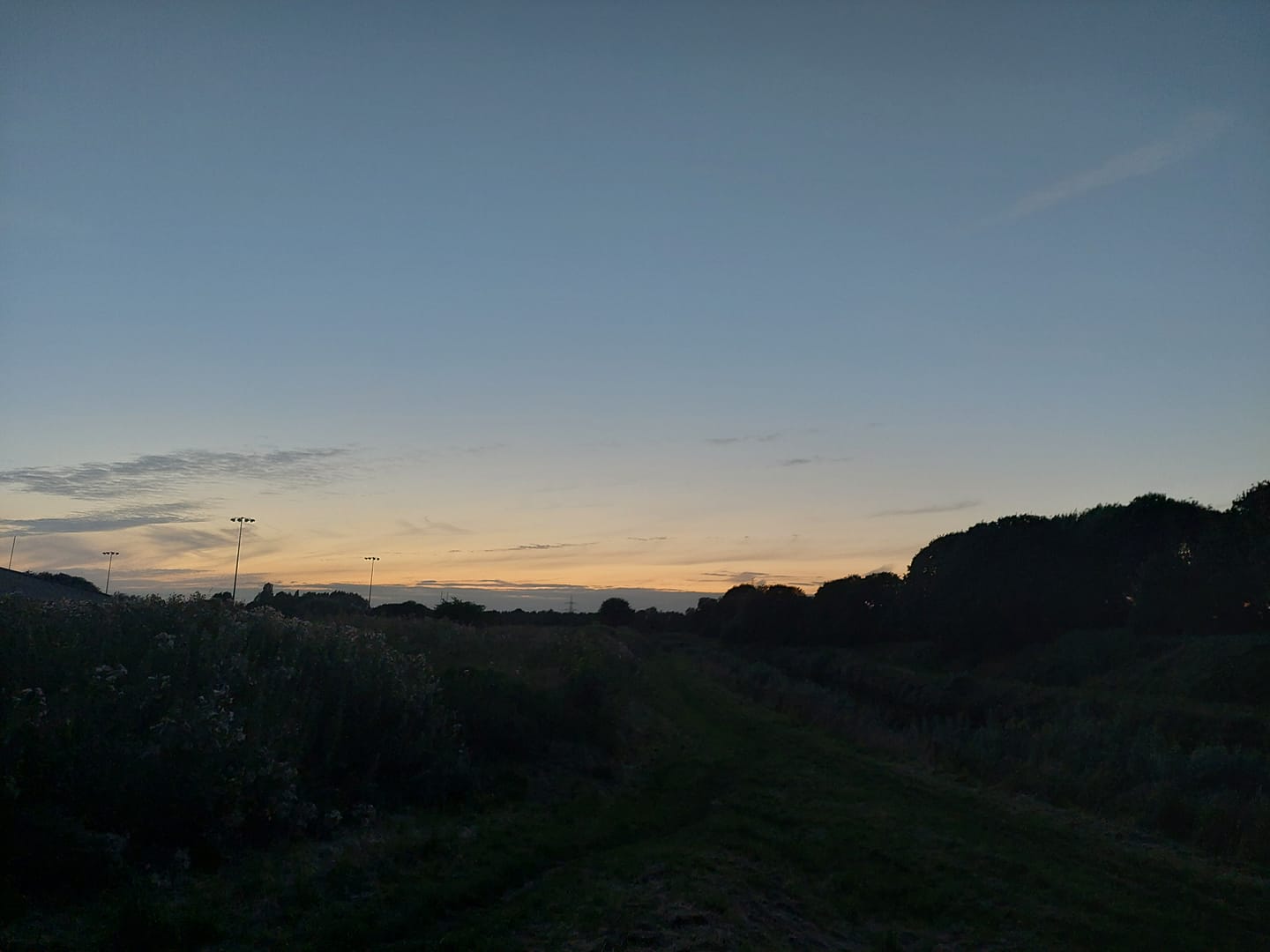
I got this picture of this sunset a couple of weeks ago in Nottinghamshire, a glorious pink and orange sky over the tree tops a few miles south of Nottingham. We stayed in a camping pod on a vineyard for a couple of nights. It already felt like the end of summer, that melancholy you get when you notice suddenly that its dark much earlier.
This song, Winter In The Woods, is from a duo known as Leaving Laurel (Pierce and Gordon- both made dance music separately before sharing some demos with each other in Laurel Canyon one day and then working on it together). Winter In The Woods is seven minutes of melancholy, starting ghostly and fragile, fading in with some static and then a gorgeous, introspective piano. Eventually a beat picks up and pushes it forward but there's no mistaking the bittersweet nature of it. The topline melody pulls at the heartstrings. The synth strings add some weight but it all feels pretty sad- dancing with tears in my eyes as Ultravox had it back in 1984.
Daniel Avery- him again- has remixed it and we're straight into classic Avery mode, drums that sound like they were recorded inside a giant metal box (and as his studio is a shipping container they probably were), the synth strings slightly in the distance and that cavernous reverb surrounding everything. This fits right in with the music he's been making recently- Lone Swordsman, Love + Light, Together In Static. Beautiful, moving, instrumental music.
Tragically, underlining all the melancholy present in the original and the remix, Pierce passed away in April this year after a terrible struggle with his mental health- Winter In The Woods, the remix and the forthcoming album are a tribute to Pierce and is dedicated to his memory and comes with the reminder that it's ok to not be ok and that you're not alone and that we all should 'slow down and enjoy life. It's not only the scenery you miss by going too fast- you also miss the sense of where you are going and why' (Pierce Fulton).
I spotted this graffiti on a piece of street furniture in Liverpool last month, the artist starting to sketch a naked woman, legs and torso with 'Oooh la la!' as a title and then stopping, for whatever reason, to write a note of explanation- 'I was drunk when I drew this soz x'. Which is lovely isn't it?
The Cramps came up last week, a clip of them I watched somewhere drew me back into Lux and Ivy's cartoon world of utterly serious rock 'n' roll business. I love The Cramps of the early 80s, garage punk with a genuinely delinquent edge, recording amped up rockabilly/ country punk, covers and originals. On 1981's Psychedelic Jungle they had Kid Congo Powers on guitar, had settled on Nick KNox on drums after a run of short term skin bashers and had moved from New York to Los Angeles where they recorded this deranged cover version of Goo Goo Muck, a 1965 garage rock 7" by Ronnie Cook And The Gaylads. A ton of echo, twangy guitar, cymbals, schlocky horror.
'When the sun goes down and the moon comes up/ I turn into a teenage goo goo muck/ I cruise through the city and I roam the street/ Looking for something nice to eat...'
By the mid 80s they'd gained a settled line up with Nick Knox still on drums and Candy Del Mar on bass. 1986's A Date With Elvis and their 1990 album Stay Sick are both blasts of rock solid songwriting, superb, honed performances and a bigger sound with slightly higher production values. Stay Sick! especially is wall- to- wall killers, one great song after another. This one, Mama Oo Pow Pow, is Lux's libido crammed into two and a half minutes with a blistering guitar/ bass/ drums attack that fades in quickly and ends the same way.
'Mama oo pow pow, who's gonna twist and shout/ Mama oo pow pow, who shot that la la out/ Your gamagoochi's got the gagas and your hoochie coochie's hangin' out/ Girl, you could use a good spankin, and baby, so could I/ I love to hear the scream of the butterfly/ Now I don't wanna be your dear sweet friend/I just wanna beat your little pink rear end'
Tullio De Piscopo is an Italian drummer/ singer/ top session percussionist whose 1983 single Stop Bajon went worldwide, slowly and gently, from Italian danceterias out to the rest of the world, to the early Chicago house scene to the Balearics, across Europe from Munich to Glasgow. It was a minor hit in the UK, one of those records bought by people when they returned from their fortnight in the sun.
Over at Paisley Dark's Bandcamp page you can find a lovely slice of late summer re- edit action courtesy of Jezebell. Slinky and slightly darker than the original, nicely insistent. Should work a treat- free to download too. And if you want more, here's Tullio on Italian TV playing the song live in glorious VHS upload low fi.
Another Andrew Weatherall sample spotting post, my continuing attempts to try to identify and pull together the sounds that made the remixes. Today, the monumental, ground breaking, juddering dance/ rock remix of My Bloody Valentine's Soon. The long gestation period that led to the release of My Bloody Valentine's Loveless album has been well documented and is the stuff of indie legend- the record that broke Creation, the album that illustrates the manic attention to detail and difficulties of working with Kevin Shields and his single minded drive and obsession with the process and art of recording guitars, the failings of various London recording studios, the hand to mouth cash existence of Creation Records, the poor health of various participants (tinnitus not surprisingly given the volume the group played at) and so on. David Cavanagh's My Magpie Eyes Are Hungry For The Prize book describes the myths and the reality in detail.
Soon first saw the public light of day as the lead song on 1990's Glider EP (along with Glider, Don't Ask Why and Off Your Face. David Cavanagh speculates in his book that the song titles from MBV's releases at this point can be seen as ripostes to Alan McGee and his frequent requests to give him some music to release). Soon is arguably the pinnacle of Shields' famous 'glide guitar' sound and technique- playing the strings and bending them using the tremolo bar. That underestimates Soon somewhat- Soon swirls and shimmers, disorientation and delight in equal measures, a riot of melodies and feedback, ghosts of guitars and washes of vocal. It rattles in with some percussion and then a storm of guitar chords, the queasy topline melodies (one that sounds very like a flute and may well be), echoing feedback and Belinda Butcher's barely there vocals. Soon is vaguely danceable and the guitar sounds, the vertigo inducing tremolo chord changes, give it a swirling, slightly out of control feel- you've had one too many, the edges of your vison and hearing are fuzzy, you're spinning and not in control. The video version here is under four minutes but the version on Glider and different mix that made it onto Loveless are seven minutes long, an ecstatic headrush of sound.
When it came to remixing it Andrew Weatherall entered the studio armed with the records he wanted to sample and MBV's master tapes. It seems that the band were a little reluctant to hand over control to a DJ/ producer/ remixer (this was before Screamadelica had been released so Andrew's reputation in the studio wasn't established). The resulting remix, released in 1990, turned the highwater mark of shoegaze into a stomping, shuddering leftfield dance record, one that as much as any is where his reputation as a remixer rests. MBV accompanied him in the studio, either to keep an eye on him or to see how the process of remixing worked (or both). Indie- dance would quickly become tainted as a label, used more in derision than admiration- people use the term to describe Weatherall's remix of Soon, but there's a lot more going on in it than just sticking the Funky Drummer underneath the guitars and adding some cowbell. There would be plenty of guitar bands queuing up to have their feedback and four square rock refashioned but no other remix of a guitar band from this period comes close to Soon in its execution or the effect it can have on a dancefloor.
The Geiger counter intro, impossibly loud in the mix, is followed by a very un- MBV voice declaring, 'Here we go'. Then one of those guitars, stripped from the original song, appears high and centre. A thumping bassline and percussion hit in. The flute/ guitar part is punched in, on its own. 'Here we go' again. More layered guitars. The drums thunder away, the guitars are looped round and round. The 'aaah aaaahhhh' vocal sample is dropped along with a guitar part that sounds like wire being wound very tight and hit. It sounds like Soon but moreso, the drift and ghostliness of the original snapped into focus, equally narcotic but a different drug. The ending is dramatic too- the elements being stripped out one by one, faders, pulled down until there's just a voice, 'aaahhh aaahhhhhhhh/ aaahhhhh aaahhhhhhhhhh'.
West Bam's Alarm Clock, a manic 1990 breakbeat/ house 12", provides some of the feel of the remix and the clattering rhythm that Andrew uses to underpin Shields' wall of noise.
West Bam had already borrowed guitars from this, Gang Of Four's What We All Want, from their 1981 Solid Gold album. Stentorian, Marxist funk rock which Andrew would surely have recognised instantly when he first heard West Bam.
Some of the vocals are taken from this song- Tides- by Claire Hamill, released in 1986, an entirely acapella album, Hamill's voice overdubbed to produce all the sounds. Go to 44 seconds in and you'll find the vocal part Weatherall dropped in- it repeats throughout the song.
Hugo Nicolson, Andrew's assistant, engineer and studio whizz, tells us that some of the voices were sampled from a Volvic advert (I can't find any trance of the advert on the internet). If you go to 3 minutes 15 seconds in this 1975 song, Funky Music Is The Thing by Dynamic Corvettes, you'll find a rhythm break that appears in the remix too- or one that sounds very like it.
The website Who Sampled Who says that Weatherall's remix takes elements, the bassline probably, from this- The Rhythm, The Feeling by Rich Nice, a 1990 hip- house single.
If anyone knows where the 'here we go' sample comes from, write in to the usual address and I'll add it to this post.
The remix came out first as a white label 12" and was labelled the Andy Weatherall Remix. Later versions would by credited to his full name. It also appeared on Creation's superb 1991 compilation Keeping The Faith (and if you're after a vinyl copy now you'd be better off finding a copy of the compilation- cheaper and containing a slew of other era defining tracks to boot). Soon in Andy/ Andrew's hands is a record and remix in a class of its own. It still sounds like Soon but it's a Soon that My Bloody Valentine hadn't imagined and one that blurs all the lines and boundaries that existed at the time- not rock, not dance, not indie dance, not shoegaze but something new built from all of these but something else as well. 'Here we go'.
Dragged up from somewhere a couple of days ago (scrolling through social media on my phone probably but then straight to my subconscious) this is Bandulu in 1993 with a track from their Guidance album that takes it all down a notch or two into ambient techno territory. Gravity Pull is a superb piece of music that pulls at the emotions while building up to a rhythmic thump too. Proof, if it were still needed, that you don't need guitars or a singer to make music that is capable of moving you.
Tenuous link incoming... today's gravity pull for me is the force pulling me back to work after the summer holiday. I've been in several times over the last few weeks but this is the official start, back in with a bump. September is here too, a month that always brings unwanted change- the evenings are noticeably darker earlier, the summer is largely over, autumn beckons, that fucking wheel keeps turning.
Psychederek is an artist who is very local to me- he plays records at a bar just a mile up the road in Stretford called Head, the first Friday of every month, a night called Psychederek's Psycho which promises disco, Balearic, bass, indie dance and Afrobeat, which sounds right up by street (literally and metaphorically). The video for his latest release is also features some very local parts of south Manchester, not least one of the streets around Stretford Arndale and the footbridge over the M60 from Kickety Brook and the Mersey to Stretford Meadows (it all sounds very romantic but don't be fooled. Stretford Meadows is built on top of landfill and rubble dug out to construct the motorway. The tip/ dump/ household waste recycling centre is next door). It's been one of my lockdown walk routes so it's lovely to see it immortalised in song- and not just any old song but a song called Screamadereka...
Clearly you don't call yourself Psychederek and release a song called Screamadereka and then expect to be taken entirely seriously but there's no joking with the song- it's a beautifully pitched, slow motion, blissed out stroll with sonic explosions, looped voices and a vocal that sounds like the sun shining. Screamadereka is out on an EP called Space Arcade, released by Sprechen, the label owned by Chris Massey (also a Stretford resident) and you can get it at Bandcamp. Disappointingly I think I have missed out on the vinyl.
There are two versions/ remixes on the EP by the combined talents of Sean Johnston (as Hardway Bros) and Duncan Gray (as Monkton), the deeply dubbed out cosmic trip of Screamadereka (Hardway Bros Meet Monkton Downtown) taking the original and separating it out even further, finding all the space between the sounds. It's a stunner.
The Screamadereka (Hardway Bros Meets Monkton Disco Dub) does the reverse, pushing the tempo up and landing on the dance floor somewhere far, far away, powered by a very wigged out bassline. On and on it goes, round and round, looping itself out of the atmosphere and escaping.
Word came out of Jamaica yesterday that Lee 'Scratch' Perry had died aged 85. He seemed to have been around for so long and seemed so ancient that the idea of him dying is faintly absurd- it looked like he would just carry on forever but (like Charlie Watts last week) it turns out he was mortal after all. Perry's recording career from the early 70s onward is the stuff of legend. His role in the development of reggae and especially dub, using the studio as an instrument, is unsurpassed. His productions from the mid- 70s, done at his own Black Ark Studio are mind-bending pieces of music- the use of space and echo, animal noises dropped in, FX bouncing around, panning from left to right and back again, his creation of acres of room in the tracks but with sounds crammed in and piled on top of each is sheer brilliance. The basslines and horns. The snippets of vocals- soul fire, roast fish, cornbread and collie weed- are like missives from another world. His razor sharp productions for Junior Murvin (Police And Thieves, almost certainly my entry point to his work via The Clash), the unbelievably, effortlessly cool Heart Of The Congos, Party Time by The Heptones, Max Romeo's War Ina Babylon, Prince Jazzbo's Croaking lizard set the standard for what reggae music should sound like. His work with Bob Marley and The Wailers was crucial in their story. His influence on the punks, not least The Clash (and his production on Complete Control, probably reeled in after the event to make it more palatable to their audience), was huge. His song with The Beastie Boys is a wonky joy. His album with Adrian Sherwood last year showed he was still cutting it.
In 1996 a compilation called Voodooism came out, a stunning collection of dub works taking in his own tracks and productions and dubs of the likes of Zap Pow, Errol Walker, Earl Sixteen, Leo Graham, The Hombres and The Black Notes. Future Dub is a dubbed out flipside to Errol Walker's Better Future single from 1977. I bought it and palye dit
Soul Fire, from 1978 and the Roast Fish Collie Weed And Corn Bread album is otherworldly- cows mooing, a skanking riddim, a sizzle and a vocal that sounds like the heat of the surface of the sun.
Brian Eno's Ambient 4: On Land came out in 1982, an album combining synthesiser notes, found sounds including animals and rural recordings, recordings from other projects that finally found a home and the contributions of musicians such as Bill Laswell, Daniel Lanois and the recently deceased Jon Hassell. The tracks reference real places- Lizard Point, Lantern Marsh, Leeks Hills and on the final track Dunwich Beach, a Suffolk port which was the victim of coastal erosion and disappeared into the sea. The album is eerie and unsettling despite the beauty of the recordings and there's a sense of loss throughout it, suggesting the faded glamour of deserted British seaside towns out of season or the ghostly weirdness of the English countryside at dusk in autumn.
The Poncho Brothers are from Yukatan, Mexico and are the purveyors psyche/ no wave/ disco. In 2015 they released their sole single, a four track 12" single with this song on it, Danza Oscuro (Dark Dance in English). It came out on Glasgow's Invisible, Inc label and you can buy it digitally here.
Scuzzy bass at the fore, a wayward groove, wiggly synths, surf guitar- lovely stuff.
I first heard it as part of this recording of Andrew Weatherall playing in a field in Italy at the Terraforma festival in 2017. Our DJ on stage with his belongings in a carrier bag, workwear, jeans with big turn- ups, braces and round sunglasses and proceeds to play a seamless mix of punk, indie, rock 'n' roll, post- punk, an anything goes approach to DJing as long as you can dance to it. Any set that contains The Poncho Brothers, Gerry And The Holograms, Fujiya and Miyagi, The Dream Syndicate, AMOR and Moon Duo (among others) is a winner. The man knew how to DJ.
Mandy, Indiana are based in Manchester apparently. Clearly my finger isn't on the local pulse because they're new to me but I haven't exactly been on the scene for some time now. Their song Alien 3 has been remixed by Daniel Avery and, well, to put it mildly, oooft...
A huge sounding kick drum- bang bang bang bang- then a snare- tsk tsk tsk tsk- and then at sixteen seconds a hi- hat which on my first listen had me laughing out loud and exhaling, not because it was funny but because it was just so... there and on it. The descending bass hoover at thirty seconds is a brain melter. Singer Valentine Caulfield's vocals, sung in her native French, are chopped up and dropped in, adding to the propulsion. Breakdown, slow siren noises, tension and release. Techno can have a real physicality about it, ribcage rattling stuff and this remix has that- even through crappy computer speakers. I can only imagine what it sounds like through a club or gig system.
Mandy, Indiana make raw, noisy, visceral post- punk. The original version of Alien 3 is pretty uncompromising and industrial and if I ever get to a point where I can attend indoor gigs again I will make a point of punishing my ears with some of this stuff.
On Tuesday night someone on Twitter said they'd always thought The Rolling Stones were immortal but the death of Charlie Watts aged 80 puts paid any notions of that. Charlie was the engine room, the provider of the backbeat, a cool and collected presence with a minimal, four piece drumkit who always seemed to treat being the drummer in The Rolling Stones as a job- a healthy attitude in that particular group maybe. Turn up, do your bit, go home. Simon Price commented, also on Twitter, that 'he had the jazz chops but he always kept it unfussy, just holding things down. And I always appreciated his quietly tolerant expression of ''These idiots...' '', which nails Charlie's onstage facial expression perfectly, sitting at the back keeping time while the others did the showing off at the front. Either that he was mentally making a list of what he needed to buy from the 24 hour garage on the way home...
This interview with Charlie backstage somewhere on the road in the USA during their 25th anniversary tour is priceless, Charlie deflecting any rock 'n' roll cliches with a remark about the reality of being in the band- 'work five years and twenty years hanging around...'
Back in 1989/ 1990 The Rolling Stones were both everywhere and dinosaurs. Sympathy For The Devil was heard all over the place, the congas and the rhythms part of the sound of the times, the woo- woo backing vocals slipping into indie- dance and acid house, the danger and glamour of the song seeping in alongside house music, De La Soul, Happy Mondays, 808 State, Soul II Soul and all the rest. On the other hand, they were old men (or seemed to be to us aged twenty), millionaire rock stars with no idea of what was really happening. When they announced the Steel Wheels/ Urban Jungle tour I remember debating with a friend about whether we should go. They had dates at Maine Road in July 1990 (it being Maine Road could have been a factor against it). We decided not to go, possibly fired up on the spirit and cheek of Ian Brown's comment- when asked whether his band would support The Stones he replied, 'The Rolling Who? They should be supporting us'. I recall thinking that paying over £20 to watch some old men play their hits in a football ground was ideologically unsound, especially with so many other younger bands to see and clubs to go to. There's a lot to unpack there in retrospect, not least the fact that in 1990 Mick, Keith and Charlie were in their mid- to- late 40s i.e. a little younger than I am now.
A month ago The 1968 Rolling Stones Rock 'n' Roll Circus was on TV. I switched over as it started and there it was. It was famously unreleased when it was recorded, Mick unhappy with the Stones performance. A few decades later, when watched again, they weren't as bad as he thought at the time and the CD and DVD box sets kept the cash registers ringing. The Stones went on in the early hours of the morning, playing in a big top after Taj Mahal, Jethro Tull, a paint stripping performance by The Who and some gritty, dirty blues from an all star band put together by John Lennon, but there's nothing poor, tired or under par about this and while the camera is all about Mick, it's Charlie locked in with Keef who are doing the work and dredging up the voodoo (and playing through a PA smaller and less powerful than most modern pub tribute bands use).
The Stones with Charlie on drums made some superb mid- 60s pop singles, brittle, bright, amphetamine songs like 19th Nervous Breakdown and Get Off My Cloud and some wonderful trippy but spiky psychedelia (Citadel, She's A Rainbow, 2000 Light Years From Home). Citadel sounds like an 80s garage band, flanged guitar, feedback, three chord riffs and Charlie's drums, slightly behind where you think they should be- dislocating psychedelic rock.
Then there are the four albums the made between '68 and '72, are the stuff of legend- Beggars Banquet, Let It Bleed, Sticky Fingers and Exile On Main Street, albums dripping with sticky, grungy, murky, sweaty, arrogant but ultimately life affirming rock 'n' roll, with some huge dollops of country and blues and pop stirred in. Street Fighting Man. No Expectations. Let It Bleed. Gimme Shelter. Live With Me. Monkey Man. You Can't Always Get What You Want. Wild Horses. Moonlight Mile. Dead Flowers. Rocks Off. Torn And Frayed. Happy. All Down The Line. Shine A Light. Charlie Watts was never just the drummer. He was the backbone and the backbeat. This song was an outtake from the Sticky Fingers sessions, unreleased until Allen Klein put it out a cheap cash in compilation several years later.
It sounds like Keith on guitar, sounds like him all day long, but the internet says it's Mick Taylor (who also wrote it and wasn't credited) and Stephen Stills. Charlie's gear changes at forty five seconds and one minute forty two drive the song and the band on, Bobby Keys' sax squawking away on top. And you think, 'this was one they decided to leave off the album...'
This one too, a Stevie Wonder cover also from 1969 and apparently recorded the night news came through that Brian Jones had died.
Steve Cobby's one man renaissance/ cottage industry continues with the release of another album- Shanty Bivouac- an eight track opus. It came out a few weeks ago but I've waited to listen to it properly and let it get under my skin before writing about it. The album divides in two, the first half more uptempo and driven by beats and the second more reflective and chilled out. Opener Saddlebags sets the scene with some Steve's trademark funk, clipped guitars and Fender Rhodes, summer fun and drinks at the bar. Ten Bob Lino ramps it up with some faster electronic beats, skittering drums and sweeping strings. Whip And Tongue is back on the funky drums and bassline, with several different synth and organ parts playing off against each other. Everyone Is A Salesman slows the pace a little, squelchy bass and bleepy melody line before some lovely organ sings over the top. The second half, side B in a vinyl world kicks in with more clattering drums, pots and pans percussion and a flute. The final three tracks are the album's highlights for me, a perfectly paced trio, the sounds pitching down to the sundown Balearic/ ambient end of things- Pick Flowers Brewmaster is a gorgeous down tempo ride, a melody tugging at the heartstrings. It's followed by 45ft Tide, an acoustic guitar and some delay, a drumbeat that sounds like it was tapped out on a work surface, the atmospherics gradually building while the guitar picks away- I keep clicking back to the start with this one, over and over. The final song, as if that wasn't enough, is three and a half minutes of piano and reverb, a happy/ sad, reflective way to finish. The song's title- Life And Consciousness And Mind And Memory And Thought and All Creation- tries to pull it all together but the piano is more than capable of doing all of that on its own.
You can buy it digitally at Bandcamp here. There's a vinyl pledge page here, which has already passed the number needed to go into production, but if you want a copy on black wax (and this sounds very much an album that needs to be heard physically) you can still pledge through to the end of this week.
In 1985 Echo And The Bunnymen released Bring On The Dancing horses, a single designed to showcase the first fruits of the work with producer Laurie Latham, recorded for the film Pretty In Pink (with one eye on a US audience) and to draw in punters to their singles compilation Songs To Learn And Sing. It was the first release following 1984's Ocean Rain and split the opinion of fans, some seeing it as too lightweight, commercial and poppy. I love it- poppy and smothered in the sheen of big studios and name producers it may be, drenched in layers of synths and melodic it definitely is, but what a tune, Mac singing of Jimmy Brown and Charlie Clown and 'shaking while breaking your brittle heart'. The 12" featured an extended mix, stretching the song out for an extra minute or two.
However it's not Bring On The Dancing Horses but the B-sides that I'm here to offer you today. For the B-sides the Bunnymen went to Strawberry Studios in Stockport and produced themselves. Flip the 12" over and you'll find a darker, grittier, looser Bunnymen. Bedbugs and Ballyhoo is first up, The song would be re-recorded for their 1987 'grey' album with Ray Manzarek from The Doors guesting on keyboards but the version on the 12" single is vastly superior. Pete on brushes, Les' bassline (the starting point for the entire song) and Will's understated guitar lines. Ian makes up the words on the spot- he later claimed the song was about imperialism (and hey, maybe it is) but I think they're just words he plucked out of the Stockport air and stitched together- bison, buffalo, cannonball, rifle, thunder, rumbles- and then the classic romanticism of the chorus, 'down on your knees again/ saying please again'. The loose, funky breakdown is a treat, Bunnymen at the jazz supper club.
Leave the 12" playing and the second B-side rips into view, a wall of noise with fuzz guitar, thumping drums and a lovely slide guitar part. Ian said in the Crystal Days box set booklet the song was intended as a riposte to the Mary Chain and the noise bands coming up behind. Ian's vocal veers between coolly disinterested/ half spoken and typically histrionic, 'never gonna change/ never disappear'.
The album they began to record after this, the self titled Echo And The Bunnymen (known as the grey album), suffered from Laurie Latham's production (which stripped the life from some of the songs), from being forced to re- record it after the record company rejected the first mixes and a loss of interest from the band. They were split into two, maybe three, camps- Ian was isolated and planning his departure (listen to The Game to see where his head was at) and Will, Les and Pete were pissed off with Ian and the whole process. Pete, everyone said, was never the same after his return from his Sex Gods trip across America. But if they'd been allowed to produce themselves and holed up in Strawberry, things could have been different- or at least the album might have been. The Game, Lips Like Sugar and some of the other songs from the 1987 album done themselves in the vein of these two B-sides could have made for a very different record. Not that it would have kept the group together, I think they were too far gone for that.
In 1989 a Danish group called Dr. Baker, Kenneth Bager's first musical outfit, released a record called Let's Dream Together, what Bager called a paradise record, the opposite of rave. Heavily inspired by Italo- house and Manuel Gottsching's E2/ E4 (and also by Sueno Latino, built around a sample from E2/ E4), the record was pressed as a one sided 12" in a very small quantity. A year later Boy George picked up on it and offered to record a vocal for the track but nothing happened. Kenneth Bager's Music For Dreams label has re- issued it thirty years later following multiple requests from a number of labels to put it back out. The master tapes were retrieved and baked, some new stems discovered and added, a bit of tinkering and hey presto! The New Age Orchestra's slice of paradise dream house from 1989 is reborn. The original of Let's Dream Together goes for silly money on Discogs. The digital re- issue can be got here for 10 Danish Krona (approximately one pound).
Last month Primal Scream announced the a thirtieth anniversary edition box set of Screamadelica, a box that will contain all the 12" singles from that album re- issued on vinyl (nine 12" singles) with a new and previously unreleased mix of Shine Like Stars as the tenth disc. The box retails at £120.99 and I'll just leave that figure hanging there.
The new version of Shine Like Stars was played on BBC 6 on Friday and then was put online. It seems that they will be releasing this version separately from the box, probably for next year's Record Shop Day just in case you didn't feel that the box set was exclusive enough. Late stage capitalism/ the music industry is such a joy sometimes.
Shine Like Stars closes Screamadelica, an album that Primal Scream made with Andrew Weatherall producing and Hugo Nicolson close at hand. Initially Weatherall, a relative unknown as a remixer and producer but flushed with the summer of love, a great record collection and the enthusiasm and confidence of youth, remixed I'm Losing More Than I'll Ever Have into Loaded and then Come Together. Higher Than The Sun and Don't Fight It, Feel It followed and Alan McGee told Primal Scream they needed to turn this run of ground-breaking, hip shaking, boundary breaking singles into an album. Weatherall got the job in the big chair and the album followed. Shine Like Stars presented some problems for them, not quite falling into place and the sequencing of the album and how to finish it wasn't quite there either until Weatherall cracked Shine Like Stars.
It's a space- age lullaby, a twinkling musical box melody and a drone, some synths and a lazy pace. Bobby sings softly about someone sleeping. After the Stones- isms, acid house highs, crunching club beats, country ballads and blissed out dub trips of the previous eleven songs Shine Like Stars is a beautiful way to trail off, the accordion and waves lapping against the beach for the final seconds of the song and the album.
It's titled Andrew Weatherall Remix but to me sounds more like an earlier mix, the song in a development form before it was completed. There's some very 1991 piano and a different drum track and then a huge synth bassline, not a million miles from the one on Safe From Harm by Massive Attack (out the same year). The backing vocals at two minutes fifty are nice, an interesting part of the song that didn't make the final cut, and then Throb's guitar comes in, a grungy 70s Les Paul solo, that bassline and the twinkling melody playing off against each other. The final minute and a half has all these eventually unused elements piling up, the ooh oohs, the jagged bassline, Throb's guitar, Gillespie singing low in the mix. It's good to hear it, an interesting version of the song and an alternative take, definitely some distance from the cosmic dreaminess of the final mix. What Mr Weatherall would have said about it, we'll never know. Whether it's worth the £120.99 to have it as part of the box set along with the nine other singles, all previously released and owned by many of us, is a decision others will have to make according to their bank balance. I'm glad it's out there.
Today would have been Joe Strummer's 69th birthday had he lived. We'll celebrate that with a song from his back catalogue, a favourite one of mine and one I've posted before. Generations was recorded for a CD compilation album called Generations 1: A Punk Look At Human Rights. In the 90s Joe seemed to flit between living in Hampshire, London, Somerset and Los Angeles. While in L.A. Joe bumped into Rat Scabies of The Damned at a Ministry gig and went backstage where they met a very frail Timothy Leary and then went out on the lash with Al Jourgensen. In the morning Joe and Rat decided to form a new band with Segs from The Ruts on bass, called themselves Electric Doghouse and recorded one song- Generations.
There's a live, one take feel about the song, the energy flowing between the three punk veterans. It's messy, the meters being overloaded and the needles in the red. The drums, bass and guitar all bleed into each other. Joe's voice has a ton of reverb on it and the words are pure Strummer-
'Back in the day/ Even circles were squares/ Radio waves/ Like pollen in the air/ When there ain't no water/ And there ain't no trees/ Just a dry wind singing/ Through the telegraph keys
And generations/ Leave resonations/ From demonstrations/ To all the destinations
I've posted some songs and remixes by A Mountain Of One before including a really sultry Richard Norris remix of Bones. Now they have returned with their first album in a decade, trailed by a 12" single with two songs, Custards Last Stand and Stars Planets Dust Me. They are a kind of sky- kissing, blissed out, ambient- folk, synth music for a future world. Listen to this, to the twinkling melody topline, the bubbling synth sounds, the padded drums and the whispered vocoder vox, the overall feeling of drifting high above the ground, surfing on warm currents, and tell me that for a few minutes life didn't feel infinitely better.
Apparently there are dub reworks by Dennis Bovell to follow as well as some Richard Norris ambient remixes. Appetite fully whetted.
Today is my grandmother's funeral. She died on 4th August at the age of 101. Her hundredth birthday party, held at the start of March 2020, was the last social gathering we all attended together before lockdown. She lived independently almost until the end (and she lived alone since the death of my Grandfather in 1997) and it was only in the last year of her life that she became unable to cope on her own and moved into a nursing home. Visiting her and only being able to see her through the window due to Covid restrictions was difficult, especially as she refused to wear the hearing aids she really needed to, which made communication harder. My Mum and any of my family who visited would write messages and news on a pad and hold it up to the window. She'd read and nod and smile. Her life was both remarkable and ordinary for her generation- Nony was born on 4th March 1920 in the direct aftermath of the First World War, she grew up in the 1920s and 1930s, served during the Second World War driving a jeep even though she'd never passed a test (and then never drove after the war, typically contrary). Her brother Michael was in the RAF and killed on a flight over Germany in 1943. She talked about him often. She married her husband, Neville Ollerenshaw and often told us that the first time she saw him he was playing snooker, 'bending over the billiards table' she would say. They travelled widely in Europe and were enthusiastic visitors to Europe, driving to France, Germany and Switzerland from the 1950s onwards at a time when, she always said, if you saw another car with British number plates you honked the horn and waved. Their house was decorated with mementoes of foreign holidays- posters from France, paintings of French castles, a Swiss cuckoo clock, little wooden figurines of people in traditional Alpine clothing. They both became teachers. She taught hundreds of children to read and although retired since 1983 was still volunteering in a local school to listen to children read until quite recently. She was a mother, a granny (to eight) and a great- granny (to thirteen, the most recent born last month).
I started to think about her age and the world she was born into. She was born in the same year as Yul Bryner and Montgomery Clift, two years before Jack Kerouac, Judy Garland and Doris Day (all born in 1922), three years older than Hank Williams, five years older than Malcolm X, six years older than Marilyn Monroe- to pick a handful of famous/ significant people. She outlived them all. It seems strange that these people and all those born in the years after the First World War were her contemporaries- it seems so long ago, another world. When she was born manned flight was only a decade old. Before she was 50 the Apollo 11 astronauts landed on the moon. When I was born (1970) she was 50. When I turned 50, she was 100. She lived an incredibly long time, lived abstemiously, swam in the sea well into her nineties even/ especially when it was a bit too cold for most of us, refused to accept she was old and when she finally did accept it said that she 'never intended to live this long'. Towards the end, a couple of months ago, she'd definitely had enough and was ready to go. By any standards she lived a very long life and although obviously it's very sad she's gone this is genuinely one of those occasions where you do feel like you can celebrate a person and their life, a life well lived and a life less ordinary. We are having a family gathering today and then in September a memorial service in Suffolk where she'd lived since the 1980s. It will be the first time as a family we've all been together since Covid and since her hundredth birthday- we'll raise a glass or two and send her on her way.
A song; I don't think she would have been a fan of much of the music I post here. Nony and Neville and my Mum were/ are all big fans of TV Westerns and cowboy films though so Frankie Laine singing the theme tune to Rawhide back in 1958 is as good a choice as any.
Two tracks that both came out recently and that seem to work together very well for me for today and both sound like they could have been put together during an all night recording session in the 1940s pill box in the photo above. When we were down in the Wye Valley in July I stumbled across it, hidden in the undergrowth overlooking the river. How long any defenders would have lasted in it is open to question. Local youths have made more use of it in the years since 1945, for various activities. You can probably imagine.
The first track is an Alessandro Cortini rework of a song from Mogwai's latest album, the amusingly titled Fuck Off Money. Cortini is formerly of Nine Inch Nails and more recently worked with Daniel Avery to produce an album of sweet, intense industrial ambient, released with some appropriateness of timing at the beginning of the first lockdown in March 2020. Alessandro's eight minute rework of Mogwai is intense, to put it mildly, and ends up like a slow motion ride through hyperspace. It's a heavy trip, in all the right ways. Buy it here.
Pye Corner Audio is a regular on these pages, his monthly tracks released during the last eighteen months acting as a sonic journal. Martin Jenkins has moved towards a kind of dark, industrial modular rave sound on some of them, a sound he has perfected with his latest one, a seven minute ride titled Murk. It's as intense and darkly beautiful as the Cortini/ Mogwai one, two sides of the same synth. Get it here at a name your own price deal.
Some songs are like planets or moons, they orbit around you and once in a while come back into your life and repeat the impact they had when you first heard them. Just as planets have longer or shorter orbits depending on their distance from the sun, so do the songs- some come back more frequently and some less so, but either way they come back. Last week a friend posted a picture on Twitter of The Wild Swans. I went straight away to their 1982 single The Revolutionary Spirit and have been playing it often ever since. It has got under my skin again. I posted it once before back in 2014 and this is what I wrote about it then...
There's something about this song, The Revolutionary Spirit by The Wild Swans, that could somehow only have been made in Liverpool in 1982, something essentially early 80s scouse about it. The Wild Swans were the baby of Paul Simpson. Paul's led three different line ups of The Wild Swans over the years but there's something really special about the first line up. Isn't it often that way? The Revolutionary Spirit was paid for, produced (in mono) and drummed on by Bunnyman Pete de Freitas and is a yearning, heart felt, uplifting, post-punk masterpiece. It was also the last record released by legendary Liverpudlian independent label Zoo.
The lyrics are a mini-epic in themselves, starting with these opening lines... 'Lost in the delta of Venus, lost in a welter of shame'... and a chorus that takes it further still... 'All is quiet where angels fear, Oh my blood relations the revolutionary spirit is here'. William Blake eat your heart out.
Label owner Bill Drummond reckoned it was the best thing Zoo put out and he might be right. Bill Drummond often is.
I can't do any better than that now other than to add that what those early 80s Liverpool bands shared was their romanticism, hopeless romantics all (in contrast to the reality of the city in front of them, abandoned by Margaret Thatcher into 'managed decline').
Songs like this one are special, they hit hard, burrow their way inside you and don't let go.
Paul Simpson lost the first version of The Wild Swans in 1982, with the other two members going off to become The Lotus Eaters. The second incarnation, between 1987 and 1990 also imploded. A third was active between 2009 and 2011. Simpson sees all three as part of the same thing, a continuum. He is also scathing about time wasted playing the game for major record labels- 'major record labels suck the poetry from your bones and fill the gaps with cement made from cocaine and crushed teenagers'.
Ripley Johnson is the man behind three bands which have been taking it in turns to hit the spot in different ways over the last decade. The four- piece psychedelic groove of Wooden Shjips and the two/ three person blissed out motorik of Moon Duo have been complemented by his cosmic country outfit Rose City Band, now three albums in. This years album- Earth Trip- is full of sublime moments, melancholic country rock with a psychedelic tint, inspired and written during lockdown as Ripley started living outdoors more- as we all have. Dawn Patrol is the album's nine minute long closing song- a gentle, radiant kiss goodbye.
Hands Of Drone is the latest project from Leicester- based artist Harvey Sharman- Dunn, a five track release of instrumentals and drones, created using analogue and digital sounds, found sounds and synths with all sorts of delay and time stretching going on. The album's first track, Hands, is almost quarter of an hour long and ideal for Sunday morning reflection and contemplation, a long industrial/ metallic drone but oddly calming. Artifice_81 is much shorter and less earthbound. Perfect (with Ben Moore) is ten minutes of edge of space stuff, minute changes in tone and timbre seeming enormous. Brother is at first ethereal but then becoming more foreground, a guitar audible in the mix, some backwards sounds (piano and guitar I think) and a sense of motion. Eventually a slide or Hawaiian guitar topline comes to the front. Last track Flowers is ten minutes of ringing, swooping and whooshing sounds with a saw taking the lead. Treat yourself to some Hands Of Drone- you deserve it.
Buy it digitally or on Ye Olde Compacte Disc at Bandcamp.
Chris Coco's Balearic/ ambient/ found sound/ folktronica label has just announced the release of a four track EP by Nick And Samantha called Summer Is Here, a release which leads with a cover of Barry White's You're My First, the Last, My Everything- but you can't hear that yet. Instead they've trailed it with a forty five second track called Cicada Interlude, which is pretty much just cicadas doing their thing and some echo/ FX. And who wouldn't enjoy that on a Saturday morning in the middle of August? I know I do.