Today's musical accompaniment is from another Ghost Box album that I've been playing recently, Outward Journeys by The Belbury Circle. The music is all early 80s synths and Tomorrow's World optimism, sequencers and driving rhythms, a homemade version of the future. The Belbury Circle is the paring of two of Ghost Bx's main artists, Jon Brooks of The Advisory Circle and Jim Jupp of Belbury Poly (you can see how they came up with the new name). Two of the songs feature vocals and synth from genuine 80s pioneer John Foxx. Journeys and travel are a recurring theme throughout the nine songs with references to cat's eyes, transport, departures and heading home in the song titles.
Cloudburst Five is a three and a half minute burst of joy, bullet train rhythms and melodic bass runs with synth toplines that sound like they've come straight from the theme tune a semi- forgotten sci fi TV series about a pair of time travelling secret agents who turn up to fight invisible enemies in a quarry in Wales with help from a group of children in parkas and some Roundheads.
I found this track at the weekend (while looking for the Intastella one) and it's struck a deep chord with me over the last few days. In 2017 Geoffroy Mugwump released a compilation album called Moving House with tracks from himself and like minded friends including Roman Flügel who contributed this one- some chilly and emotive electronics, pulsing bass, a rattling snare and sweeping synthesised strings. Plenty of Kraftwerkian vibes going on. Moving house indeed.
London Calling side three- the shortest of the four sides of vinyl that make up London Calling, only four songs compared to five on each of the others (and one that is less than two minutes long). In a way it is the oddest of the four sides. Sides one and two, from the opener and title track through to Rudie Can't Fail and then from Spanish Bombs on the flip running through to The Guns Of Brixton, have a real flow despite their wide range, from rock 'n' roll to jazz to reggae. Side three seems a bit like the place where they put the four songs that wouldn't fit anywhere else. That's not a criticism of any of the songs as such, more that the jumps from one to the next are bigger, they seem less sonically unified.
Side three starts with the group's cover of Wrong 'Em Boyo, originally by Jamaican ska outfit The Rulers in 1967. Paul had brought the song into the rehearsal sessions at Vanilla and it was still there by the time they came to record with Guy Sevens at Wessex. It kicks off with Mickey Gallagher's organ, the band vamping and Joe bawling out the opening line about Stagger Lee meeting Billy at a card game. At thirty seconds, just like in the original, they grind to a halt and Joe calls out 'start all over again'. Mick, Paul, Topper and Gallagher come back in with the skank, the Irish Horns are back and everything goes ska . Lyrically Wrong 'Em Boyo calls out the cheats and the hoodlums- 'why do you cheat and trample people under your feet?/ Don't you know it is wrong to cheat a trying man?' and 'you lie, steal, cheat and deceit/ in such a small, small game'
The Stagger Lee myth goes back to the late nineteenth century. Stag, real name Lee Shelton, and Billy Lyons had a drunken altercation while playing cards on Christmas Day. Stag shoots Billy dead. Stag O' Lee (or Stagger Lee) would be picked up later and die in prison. The myth became a standard for song writers and singers from Fred Waring in 1928 to Lloyd Price in 1959 to Nick Cave in 1996.
Greil Marcus wrote about the Stagger Lee myth in his book Mystery Train in a chapter about centred around Sly Stone. In 1991 Joe would go on to star in a Jim Jarmusch film of the same name playing a washed up Englishman freshly abandoned by both work and his girlfriend who gets caught up in a robbery.
From Wrong 'Em Boyo we head straight into side three's first Strummer/Jones original, the epic Death Or Glory. Mick wrote one of his best tunes with this one, a full on rocker packed with melodies, lead lines and riffs and Joe came up with a lyric that explores the entire myth of youth, ageing and rock 'n' roll, first expressed by The Who a decade earlier, the one about dying before getting old. Mick's acoustic guitar opens up, Paul's bass bouncing in too, then an electric guitar picking out a lead line before the moment with the crunching riff at twenty two seconds where they're all totally on it and in it. Then Joe-
'Now every cheap hood strikes a bargain with the world
Ends up making payments on a sofa or a girl
'Love' and 'Hate' tattooed across the knuckles of his hands
The hands that slap his kids around 'cos they don't understand...'
Clang! Clang! Chorus, Joe and Mick together, in unison...
'Death or glory
Become just another story
Death or glory
Just another story'
For all the myth making of Rudie Can't Fail and The Guns Of Brixton, the braggadocio, the group's rebel image, the court case for shooting racing pigeons and love of trouble with the law this is a counter balance. The cheap hood in the first verse is a frustrated and violent middle aged man. His kids feel his wrath and they don't know why he's angry. The rebel rock 'n' rollers, the boys in the band, get the same treatment in verse two-
'And every gimmick hungry yob digging gold from rock 'n' roll
Grabs the mic to tell us all he'll die before he's sold'
Joe is surely pointing at himself here as much as Roger Daltry or Mick Jagger and then the killer line-
'But I believe in this and it's been tested by research
He who fucks nuns will later join the church'
The rock 'n' roll dream dissected in four lines and destroyed. We always become what we once hated. Youth inevitably gives way to ageing. The hippies sold out, the punks have too. Whatever comes next will do the same. Nothing special to see here, just another story. Another crunching chorus and then the song breaks down. Topper runs round the kit, Joe squawks, Paul's bass runs up and down, Mick peels some lines off and then they start to build back up for another chorus, Joe with a spoken section...
'Fear in the gun sights
They say 'lie low'
You say 'OK'
Don't wanna play a show
No other thinking
Was it death or glory now?
Playing the blues of kings
Sure looks better now'
After the chorus Joe shouts out to all the groups that haven't made it, all the garage bands-
'In every dingy basement, in every dingy street
Every dragging hand clap over every dragging beat
That's just the beat of time, the beat that must go on
If you've been trying for years we've already heard your song'
Whether Joe's sympathetic or thinks they're wasting their time isn't entirely clear, the chorus comes in again with the claim that death or glory is just another story. This verse could be a shout out to the unheard of bands or just telling them there's nothing new under the sun. Strummer, who spent quite a few years struggling and trying to make it and who left his previous band in the lurch when the new thing came along, is saying here that it doesn't matter, it's all bullshit, we all kill the thing we love and grow old. I've never been able to decide if this is cynicism or realism. But it's a great song, one of the album's highlights. It doesn't stop there either, there's a rousing final section following the breakdown where Mick's acoustic guitar and Paul's bass bubble up again, Joe talking about 'we gotta march a long way/ fight along time/ we gotta travel over mountains... we gonna cause trouble/ we're gonna raise hell'.
So maybe despite the hypocrisy of becoming what you stood against, the struggle is still worth fighting, the pursuit has to take place. Just another story.
The split second gap between songs occurs again, the guitars of Death Or Glory stop ringing and we're into Koka Kola with some sound effects and Joe calling out 'elevator going up!'. Koka Kola is a sub- two minute dash, Joe singing about the power of advertising and the corporate world (and with a mention of the White House, politics too). Coked up ad executive goes to meetings, sells products, does more drugs, hangs out with party girls, Koke adds life. It's an album track on a side made up of of one offs and it's all over pretty quickly as Joe shouts out 'freeze, hit the deck'. Slagging off the world of advertising was of course just one of many things that would lead to critics of the band accusing them of hypocrisy. In 1991 Should I Stay Or Should I Go was used to sell jeans for Levi's. In 2002 London Calling sold cars for Jaguar. In 2012 it was used again, this time for British Airways.
Then we get to side three, track four and The Card Cheat, the least Clash sounding of any of the songs on London Calling and one of my favourites. It was recorded late on in the sessions, Mick and engineer Bill Price trying to get that Phil Spector Wall of Sound by recording every instrument twice, doubling everything up. Led by a Mick Jones double piano part and slamming drum and guitar parts and Mick's vocal, totally overwrought but utterly heartfelt, telling the story of 'a solitary man crying 'hold me'... because he's-a lonely'. He's doomed of course, the card cheat must pay for his crimes (just as Billy did at the start of side three), and 'he won't be alive for long'. The card game plays out, the King of Spades is put down but the dealer has cottoned on, something's wrong, and soon the cheat is forced to his knees and shot dead. The horns swell, the pianos pound away, it's all very cinematic and grandiose. Apparently Joe wrote the words and Mick sang them and there's a classic Joe lyrical switch and suddenly we're back in Death Or Glory territory, Joe looking at the sweep of human history-
'From the Hundred Years War to the Crimea
With a lance and a musket and a Roman spear
To all of the men who have stood without fear
In the service of the King'
In other words, this has all happened before, it's just another story, nothing is new- like the dingy basements and dingy streets two songs before. A pointless death over a card game and pointless deaths in wars. Joe then hands out some advice-
'Before you met your fate
Be sure you did not forsake
Your lover, may not be around'
Mick's brilliance as a musician, an arranger and in the studio is all over this song, always threatening to cross the line but completely convincing. At the end of the song the first verse comes back in, a re-run and a loop, the solitary man crying 'hold me' who won't be alive for long. Maybe this is the point of side three, the songs are linked by their lyrics and themes: the card cheat and murder in Wrong 'Em Boyo and a myth that had already been around for nearly a century; the rock 'n' roll, hope I die before I get old myth; the adman who's sold his soul to Koka Kola; the man in The Card Cheat, going through the motions that will lead to his death, the same old story for two thousand years. Everyone missing the point, looking for the quick win and easy money but failing to see that 'their lover, may not be around'.
That's my thoughts anyway. There's enough room with these songs that you may have different interpretations. I've been listening to side three and getting different things from it since first hearing it in 1989. None of the songs are the band's best known but two of them (Death Or Glory and The Card Cheat) are the equal of any others on this record. They also set us up very nicely for side four which comes in with a rare misstep but soon puts things right.
In 2002 Drexciya released Grava 4, yet another inventive and adventurous album from the Detroit duo. Sparse electro, spacey techno and their slavery/science fiction back story in one perfectly realised package. The albums eight tracks culminate in the swansong Astronomical Guidepost, a lengthy, slightly forlorn piece of techno that also points to a way out. The drum machine rattles away, electronic arpeggios come and go, synths buzz and occasionally a voice interrupts to say 'use the star chart to fix the celestial navigation point, from there you should be able to plot your way back to Earth'.
Gerald Donald and James Stinson had a detailed and highly politicised background- their four albums plot out the story of pregnant slaves who were thrown overboard from Atlantic slave ships. Their children evolved to live underwater in a place called Drexciya. They later expanded this- the Africans kidnapped as slaves who became the Drexciyans were originally from Ociya Snydor, a planet deep in the outer space, 700 million light years away from Earth. Stinson died in 2002 and Donald doesn't talk much about Drexciya so the albums and the highly charged political legend are all that remain- dark Detroit electro/techno that had its feet on the dancefloor and its eyes on the US's history of slavery.
It was sad to read of the death of Little Anthony this weekend. Anthony was a member of Intastella, the group's dancer (he's pictured on the cover of their album, crouching in the centre between two bikers). He was a well known character and face around town and many people, myself included, will have shared a dancefloor with him at some time since the late 80s. Maybe even a podium in Paradise Factory in the 90s. RIP Little Ant.
In 1991 Intastella released People, a glorious six minute piece of psychedelic dance- pop.
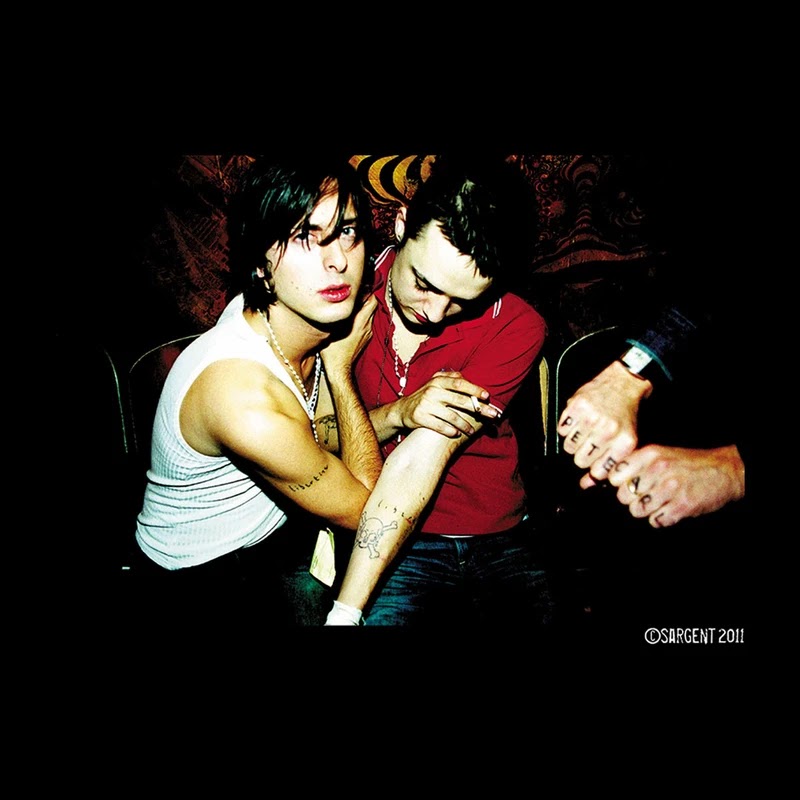
It's December tomorrow and, unavoidably, the start of advent. Half Man Half Biscuit have a line for most occasions and today's is from 2009's Shit Arm, Bad Tattoo' (the owner of the limb in question is pictured above, either Pete Doherty or Carl Barat, or both). Nigel Blackwell takes them to task for many things, not least this-
'Advent on the high street
I point and sing
Busk when it's Christmas
You only busk when it's Christmas'
Achtung Bono, the album this song is from, is peak HMHB. Every song, all fourteen of them, is a laugh out loud funny, damning indictment of modern life. In Shit Arm, Bad Tattoo Nigel Blackwell deals with The Libertines-
'I could have put my head in a bucket full of porridge And moaned about the hospital parking scheme I would have saved fourteen pounds That I just splashed out on your second album For that’s what it’s akin to And furthermore You’ve got a shit arm, and that’s a bad tattoo' The word 'furthermore' isn't used enough in popular music. Then he takes to task people who put the letter S onto the end of the Book Of Revelation (and those who do the same to Mary Hopkin). Unfortunately Pete and Carl do this in What A Waster-
'When she wakes up in the morning
She writes down all her dreams
Reads like the Book of Revelations
Or the Beano or the unabridged Ulysses.'
Just before the guitar solo he sings 'authentic Celtic band'. I've always assumed this is also a tattoo reference but it could be a musical group I suppose.
London Calling side two, pick the arm up, place the needle carefully on the outer ring, let it find the groove, a little static, and then... Spanish Bombs kicks straight in, Topper's drum salvo followed instantly by organ (played by Mickey Gallagher on loan from The Blockheads) and Mick's guitar line, a crashing, uptempo chord sequence with Joe and Mick doubling up on part of the vocals. Joe had really taken Bernie Rhodes' advice about lyric writing to heart- forget love songs, write about the world- and Spanish Bombs is Srummer at his best, contrasting The Spanish Civil War and 'the days of '39' with the growing tourist industry of the late 1970s, 'Spanish weeks in my disco casino'. The Basque separatist group ETA were active meaning the bombs of the song could be from the 1930s and the 1970s. In the midst of all this imagery, firing out of the speakers with the music piling ever onward, Joe finds space for some really memorable lines, lines about the murdered poet Federico Lorca, a hero of Joe's, killed by Franco's fascists, lines about 'bullet holes in cemetery walls' and 'hearing music from another time' and the chorus in Spanish-
'Spanish bombs, yo te quierro y finito Yo te querda, oh mi corazón Spanish bombs, yo te quierro y finito Yo te querda, oh mi corazón'
Federico Garcia Lorca In his novel Powder Kevin Sampson, writing about a fictional rock band in the 90s based loosely (or closely) on The Verve, has a character explain that the tune for Saturday Night (by Whigfield, an international pop- house hit in 1994) and Spanish Bombs are the same- you can sing the words of one over the other. Since discovering this I have never, ever got tired of singing Spanish Bombs over Saturday Night. After Spanish Bombs comes The Right Profile, Joe throwing his subject matter net wider still with a song about movie heart throb Montgomery Clift. The song begins the staccato stabs of Mick's guitar and a hi- hat, Joe reeling off the films Clift starred in- 'say, where'd I see this guy? In Red River? A Place In The Sun? Maybe The Misfits? From Here To Eternity?'
Montgomery Clift (left, seated) with The Misfits including Clark Gable (right) and Marilyn Monroe (duh) Montgomery had a car crash that left him with a broken jaw and facial scarring. He'd hit a tree leaving a party at Liz Taylor's, pumped full of pills and booze. From then on he'd only be photographed from the correct side and angle, from the right profile. Producer Guy Stevens had given Joe a biography of Clift and suggested he write a song about the star's life. Joe, no stranger to drugs and alcohol himself, wrote about the last ten years of Clift's life, from the crash in 1956 to his death in 1966, a death some called the slowest suicide in cinematic history. Mick arranges the group and has The Irish Horns swinging about all over the place, everyone speeding up and slowing down, veering left and right, Paul and Topper driving things like Clift's car with Joe garbling and gurgling the words over the top, breaking down completely for the 'nembutal/numbs it all/but I prefer/alcohol' part. Joe gives voices to the crowd standing and staring- ' And everybody says'what's he like?', 'is he alright?/ can he still feel?' and 'it's not funny/that's Montgomery Clift honey!'. No other band, certainly none of the class of '77 could have written this, the music or the words. 'Go get me my old movie stills/Go out and get me another roll of pills/There I go shaking again but I ain't got the chills'. Poor Monty. Side two, track three is Lost In The Supermarket. Near Joe's flat in the World's End Estate was a supermarket, the International (numbers 471- 473 King's Road). After a disorienting late night shopping visit Joe went home and wrote Lost In The Supermarket, a song about the alienating effects of capitalism, commercialisation and the way the world depersonalises the individual- Joe only came in for a special offer, 'guaranteed personality' and left bewildered and broken. Mick wrote a lovely, slick tune for the song, a gliding chord sequence. The rhythm section, led by Topper's brilliant drumming, complement it completely. Joe sings about the suburbs (where he'd lived) and life in high rise flats (where Mick lived with his Nan, overlooking the Westway). As the song grooves on, a smidgen of disco in the drumming and guitars, Joe develops his theme- 'I'm all tuned in, I see all the programs I save coupons for packets of tea I've got my giant hit discotheque album I empty a bottle, I feel a bit free The kids in the halls and the pipes in the walls Makes me noises for company Long distance callers make long distance calls And the silence makes me lonely'
Joe gave the song to Mick to sing, a gift, saying he wrote it partly with Mick in mind. From intro to fade out Mick sings and plays beautifully and Paul's bass playing is streets ahead of where he was two years previously.
Three magnificent songs into side two and there are a pair of songs to come that are as good as anything the band ever did. Clampdown opens with a squeal of feedback, the tsk- tsk- tsk of Topper tapping the cymbal and Mick bawling '1-2-3-4' off mic before the descending riff plays through for a few bars. Joe mutters over the top, words that are almost inaudible- 'The kingdom is ransacked The jewels all taken back And the chopper descends They're hidden in the back With a message written on a half-baked potato The spool goes 'round Saying I'm back here in this place And I could cry And there's smoke you could click on' ... and then the smoke clears, leaving Topper's boom thwack boom thwack, Mick counting everyone back in again and then the question 'what are we gonna do now?!' Joe answers with a song about the rise of the far right, the dignity and indignity of labour, the crushing of youthful dreams and becoming what you once stood against, conformity and coercion, and a final part about 'evil presidentes getting their due'. The band are on fire, fully amped up, Mick leading the charge, and the effect is electrifying. Paul's bass playing is upfront and centre, especially in the remastered version from Sound System. Joe and Mick trade lines, call and response, intuitively- the segue from Mick's spoken middle eight to Joe coming back in with the 'But you grow up and you calm down' is hair raising. It's worth pulling a few of Joe's lines out, starting with the astonishing first line of the first verse- ''Taking off his turban They said 'is this man a Jew?' '' Joe follows it with 'they put up a poster saying 'we earn more than you', the divide and conquer politics of the far right dissected in a few lines. ''We will teach our twisted speech To the young believers We will train our blue-eyed men To be young believers" Forty years on from the National Front's resurgence we're right back where we were. The racists and immigrant scapegoaters that have dragged our politics and public life into the gutter over the last decade are still at it, people now emboldened by the rise of the populist scaremongers. If as he said last week the Clash are his favourite band it's pretty clear that Boris Johnson wasn't listening to the words. 'No man born with a living soul Can be working for the clampdown' Joe urges the youth not to give in, not to fall in line, warning them of the older generation- 'The men at the factory are old and cunning You don't owe nothing, boy, get running It's the best years of your life they want to steal'
He also warns of being co-opted by them-
'So you got someone to boss around It make you feel big now You drift until you brutalise Make your first kill now' The song was originally called Working And Waiting and the lyrics must have started as a warning about the grim realities of work. School leavers in the 70s were factory fodder and with the destruction of manufacturing industry and rising unemployment even that vanished. As the song fades out and the group bash away Joe and Mick continue to hammer it home, 'work, work, work/ I give away no secrets/ work, work, more work, more work'. A major piece of work by Joe (the words) and Mick (the tune) and the group rise to the occasion pulling together a hard rocking song to match the lyrics. In a way it's a much an epic in its scope as (White Man In) Hammersmith Palais was a year before or Straight To Hell would be a few years later. Clampdown In 1980 The Clash played Lewisham Odeon, with this blistering take of Clampdown recorded on film. Is there a better sight in rock 'n' roll than the moment at fifty two seconds where the three frontmen, all in black, step up to the mic to bellow the first line in unison? Also in 1980 they played New York (a whole other story) and appeared on the TV show Fridays where they put everything- absolutely everything- into this performance of Clampdown.
Sometime during the recording of Give 'Em Enough Rope Paul realised that the money came from songwriting and during the rehearsal sessions at Vanilla brought in a song, initially known as Paul's Tune. It would become The Guns Of Brixton. Someone wrote somewhere that The Guns Of Brixton contains the greatest bassline of the Twentieth Century. Over this thundering, reggae inspired bass Mick adds some texture, some scratchy guitar and Topper splashes the cymbals. The sound of the studio chairs having their Velcro ripped apart is in there too. Joe was given an early version of the lyrics, which Paul wasn't sure about, and Joe encouraged him to work on them. When the words were finished and the music recorded Joe was given the lyric sheet but handed it back to Paul, saying he should sing it. Paul sings/shouts his words, South London style, a song about police brutality and the ghetto, suffering and surviving. He then brings in Ivan from The Harder They Come- 'you see he feels like Ivan/ born under the Brixton sun/ his game is called surviving/ at the end of The Harder They Come'. The dub rhythm swings and lurches, Paul throwing the bass around, moving from one foot to the other. The Guns Of Brixton sounds massive, filling the room when played loud. It is one of the most enduring of the songs off London calling, the bassline reverberating through pop culture as a sample and a cover version. The perfect way to close side two, under heavy manners. There are five songs on side two, five standouts, five album tracks better than most band's singles. They must have known how good they were when sequencing the album. It has flow, range and depth, showcases their quality as songwriters, inventiveness as players and Joe's unique abilities as a lyricist. As much as London Calling is an album about the world in 1979, the state of things in London and the faraway towns, it's also an album about people and their lives, the way they respond and react to the world, a world which kicks them and brutalises them and threatens to flood their homes. It's an album about Jimmy Jazz and Rudie, the narrator of Hateful and his dealer, Federico Lorca, Montgomery Clift, Ivan and Joe dazed and confused under the supermarket striplights. The Clash were a people band, they did things for their fans (letting them into gigs for free, not over charging them for albums, not stripmining albums for singles) and they wanted to reach as many people as possible. Writing about people was what they did. As Joe pointed out much later 'without people you're nothing'. In a few days- side three.
One of my favourite 12" releases of 2018 was Craig Bratley's 99.9%, which came with an Andrew Weatherall remix and a gorgeous piece of slo- mo cosmic Italo called Take Me To Bedford Or Lose Me Forever. Craig has just put out another four track e.p. (which the postman delivered yesterday, raising his eyebrows no doubt at the number of 12" square packages that have been arriving at our house recently). The new e.p. is called A Message From The Outpost and finishes with this- Running To Paradise- another wonderful slow mo, cosmic/Balearic transmission gliding in from much warmer and sunnier climes. Rimini in 1991 perhaps.
Back in 2013 Craig remixed a track called One Time by Almunia (an Italian psychedelic/cosmic disco outfit) and which shows he's been perfecting this Italo groove for some time. As this one hits the three and a half minute mark the acid bassline and synth throbs become enough to make a grown man cry.
It's so dark at the moment- dark in the mornings, dark from the late afternoon and murky throughout the day- that some musical sunshine is required to try to burn though the gloom. This track came out in 2017, a blast of Italo, cosmic Balearica with a touch of acid thrown in. Prins Thomas did an official edit of a Rusty track called Everything's Gonna Change and when that was released by Hell Yeah Recordings he added two extras, one of which was this one, Gran Paradiso. Straight from the off a blaze warm and loud washes of synth, drum pads and some chirruping sounds with a spluttering synthesised bassline coming in. Four minutes of summer.
In three weeks time, 14th December to be exact, London Calling will hit forty. My copy (pictured above) was purchased second hand at some point in the late 80s, already a decade old then. Since then I've ended up with three copies on CD- a plain re-issue, the 25th anniversary re-issue with the Vanilla Tapes and the remastered one from the Sound System box set. Sometimes I think I should replace my vinyl copy which has seen better days but baulked at the price of green and pink re-release. And in many ways I'm happy with my original copy- it's lived in and we've all got a little worn over the last forty years.
There's an exhibition on at the Museum of London celebrating the album with Paul Simonon's smashed up Fender Precision bass as one of the exhibits. We can sit here and blather about punk hitting middle age and ending up behind glass in cases in museums, surely not what punk was about, and moan about them selling out- and people were accusing The Clash of selling out from the moment they signed to CBS right through to now- but instead I'm going to focus on the record, the nineteen songs spread over four sides of vinyl that make up what may very well be the Greatest Rock 'n' Roll Record Of All Time. I don't especially care for Best or Greatest Of All Time, it's all subjective and one man's trash is another man's treasure, but if I were forced to have cull the majority of my record collection, to pare things back to the absolute minimum, London Calling would be one of the survivors. I can't imagine my listening habits without it.
Some context- in 1979 The Clash were in a bit of a hole. They'd moved on from the purist, Year Zero-ism of 1977 and had faced some criticism for the Sandy Pearlman produced Give 'Em Enough Rope. In 1979 they'd put out album track English Civil War as a single complete with the magnificent cover version of Pressure Drop on the B-side. In May they released the four track Cost of Living e.p. a record so red hot it almost couldn't be contained by the 7" of vinyl it lived within- a searing cover of I Fought The Law (more grist for their detractors, rebel chic plus someone else's song), two new originals in the shape of Groovy Times and Gates Of The West (yet more grist for their detractors, the band who in '77 were so bored of the USA but were now singing about it) and a new recording of Capital Radio (Capital Radio Two) to beat the scalpers charging over the odds for the original.
The group had changed management, ditching Bernie Rhodes, which led to them leaving their Camden rehearsal base and both Strummer and Jones admitted after that they'd suffered from writer's block. For what would become the London Calling sessions Clash tour manager and roadie Johnny Green and Baker had secured them a new space, the back of garage in Pimlico, re-christened Vanilla Studios. They locked the doors, kept people out and began playing around with covers that each of the four members brought in from their background and wide range of influences- rockabilly, rock 'n' roll, reggae, ska, rhythm and blues. In the afternoon band and crew broke off for football over the road, a couple of pints and then back to the rehearsals. From this they assembled the songs that would become London Calling, three cover versions (four of you include the cover of Armagiddeon Times on the B-side to the lead single), one song written right at the end after the sleeve had already gone to print, a first song and lead vocal for Paul and fifteen Strummer- Jones originals. They recruited semi- retired, semi- legendary producer Guy Stevens to produce the album, tracked down by Joe in a pub. Stevens caused chaos in the studio, deliberately, to get the group into the right frame of mind, a rock 'n' roll atmosphere (which all four said they thrived on). They spent six weeks in Wessex Studios, Bill Price stepping in when Stevens went too far, and came out of it with a double album that they insisted would retail for under a fiver. Value for money was a key punk concern. London Calling may not be punk but it is made of the punk aesthetic- do it yourself, loud and fast, keep mistakes in if they add to the song, don't do what they tell you to- spliced into roots music and rock 'n' roll. It is personal and political, local and global, London and the faraway towns.
Side One
Opening with the strongest statement of intent they could, the title track and single crashing in on Jonesey's two chord intro and Simonon's rumbling bass, a clarion call. Joe strikes out straight away, looking out from the capital to the rest of the country- 'London calling to the faraway towns/ now war is declared and battle come down'- with a state of the nation address taking in the death of the 60s ten years earlier and punk a couple of years before, police brutality, impending nuclear and climate apocalypse, starvation, the zombies of death (a line widely thought to be a reference to heroin carving its way through the punk scene) and Joe sitting in his flat on Chelsea's World's End estate, where he lives by the river. Joe took an early version of the lyrics to Mick, who told him to re-work them as the chorus wasn't strong enough. Imagine that. The song ends with a burst of radio pips and Joe's plea 'London calling at the top of the dial/ and after all this won't you give me a smile?'
Then it's immediately into their cover of Vince Taylor's Brand New Cadillac. One of the attentions to detail on this record is the gaps between the songs and the instances of split second timing. No sooner has London called than Simmo's bass takes us into the rockabilly flash of 'My baby drove up in a brand new Cadillac'. This was the first song recorded at Wessex, the cover version warm up sessions paying off. Topper said they'd have to redo it to, it speeds up in the second half, to which Joe Stevens replied 'all great rock 'n' roll speeds up'. From there on in they were flying. 'Balls to you baby', Joe sneers updating Taylor's 50s single to the late 70s, 'she ain't ever coming back'.
Jimmy Jazz is a change of pace, initially a laid back sounding jazz- blues song, Mick's guitar playing decidedly non- punk, all echo and space. Joe comes in over the swinging backbeat with a tale of the police looking for Jimmy, threats to cut off his ears and head, Jimmy Dread and Satta Massagana, Joe eventually going all scat. Jimmy Jazz is the big sign on first listen, half way through side one, that things have changed, that other influences are all over this record. Jimmy Jazz, after the strum and drang of the title track and the amped up rockabilly of Brand New Cadillac, is a breather of kinds.
And then blam! Hateful, a three minute, three chord trick, a rocking Bo Diddley shuffle with lyrics about heroin addiction (again) and in the 'this year I lost some friends' a reference to Sid Vicious and his sad death in New York. Even their throwaway side one track four album songs are better than most band's singles.
Side One closes with Rudie Can't Fail, very much a London song, Mick responding to Joe's instruction of 'sing Michael sing' with a shouted 'on the route of the 19 bus...' We're deep into ska and reggae territory, horns driving the song emphatically, again with that Bo Diddley shuffle and beat. A celebration of the West London rude boys and drinking brew for breakfast, the youth being criticised for not settling down, getting a job from the paper and taking responsibility. In response Rudie loves his life, 'I tell you I can't live in service' he says, 'looking cool and speckless' in his pork pie hat and chicken skin suit. The band's rhythm and ska builds up, the guitars choppy and the horns parping. It's clear whose side The Clash are on.
Side One takes in so much in it's five songs, from apocalyptic modern rock to cool jazz, from rockabilly to funky reggae, it's tempting to just flip the needle back to the start and go through it all again. The band are flying, Joe's on fire lyrically and the songs up the ante from one to the next covering more musical ground than any other punk band would be able to. And that's before you've even flipped the disc over and played side two, possibly the greatest run of Clash songs they committed to one side of black vinyl. And I'll come back to that soon.
Based on two posts by The Swede I started to check out the back catalogue of Swedish band Kungens Män, six middle aged men from Stockholm who have been exploring the outer limits of psychedelic and drone rock since 2012- there's a lot of krautrock in their sound and some shoegaze too. They're playing in town in early December for the princely sum of £8 so I'm going along to that too. There's plenty of back catalogue to get stuck into, enough to keep me going for some time. But for today, their latest release, an album with not one or two or even three long songs but four long songs.
Kungens Män's latest album is a four track called CHEF (not a reference to the head cook but a word for the boss or the chief) . Opener Fyrkantig Böjelse (square bend, according to Google Translate, not always the most reliable source of translations) is eleven minute of dark, metronomic space rock with some trippy guitar playing. It's followed by eight minutes of Öppen För Stangda Dörrar, dubbed out, spacey and wind swept and building slowly in intensity. Track three is the ten minute fuzz bass romp of Män Med Medel (Man With Funds I think), with ensuing guitar freak out, the drumkit taking a right old battering. Album closer is the eleven minute Eftertankens Blanka Krankhet, repeated, cycling guitar parts and a hypnotic groove.
Two random and unconnected pieces of Twentieth century pop culture for Sunday. The picture is a photograph/mixed media collage by Man Ray from 1941 titled Les Filles des Noix (Nut Girls). Forty five years later came the song below- Carino by T-Coy- a delicious marriage of Mancunian house and Latin music, created by the magic hands and imaginations of Mike Pickering, Richie Close and Simon Topping. It still sounds as fresh as you like. Carino, which has the honour of being the first UK house release and existed as early as 1985 before being released on Pickering's fledgling Deconstruction label in 1987.
Today is our eldest's 21st birthday. Isaac was born on 23rd November 1998 and, as some of you will know, from that point on has had a complicated and difficult time. Diagnosed with a serious, life limiting condition at eight months, multiple operations, deafness, physical and learning disabilities, all compounded by meningitis at ten years old (a result of the refusal of his immune system to grow back following two bone marrow transplants in 2000). Along the way he has refused to stop or slow down and brought joy and laughter to almost everyone he meets- questioning them about the motorways they use, the day their bins go out, the tram or train stations they use and the supermarkets they shop at. He is now in his second year at college and loves it (his college in Salford integrate the young adults with additional needs with the mainstream students on one campus). He goes out with his adult social services group, a service that has somehow survived repeated cuts by the Tory government and council over the last ten years. Things have been on a fairly even keel in recent years but you can't ever really take things for granted with him (his immune system is still shot to pieces) so twenty one is an achievement, a marker, especially for a young man who more than once while in hospital wasn't expected to survive the night. Happy birthday Isaac.
I only twigged recently that this event was also on the 23rd November, nine years earlier. The legendary night in 1989 when Top Of The Pops was gatecrashed by Happy Mondays and The Stone Roses. At the time in '89 I remember sitting in my student house, finger poised over the record button on the rented VHS machine. Happy Mondays came on first, miming Hallelujah, the lead song off the Madchester Rave On e.p. Hallelujah on the 12" is a colossal, six minute piece of grinding Mancunian funk, produced by Martin Hannett pumped full of pills the Mondays gave him, not the kind of song to make the nation's favourite chart show. The 7" featured a Steve Lillywhite mix (The MacColl Mix) slightly smoothed out with Kirsty on backing vox. It still sounds like a groovy, out of sync, unholy racket, Shaun William Ryder wanting to 'lie down beside yer, fill yer full of junk'.
Kirsty joined the band for the TV appearance, dressed down in double denim and trainers. The Mondays had been to Amsterdam before the show for some 'shopping' and were all Armani-d up. As the cameras began to roll Shaun asked the nearby cameraman 'does me knob look massive in these strides?' Bez apparently remembers nothing of the day at all.
The Stone Roses appeared shortly after having ridden into the top ten with a double A-side, Fool's Gold and What the World Is Waiting For. The forty date spring tour and debut album saw them grow and grow, bringing more and more fans on board, hair was lengthening and trousers widening. Fool's Gold was a step on completely from the album, nine minutes fifty three seconds of liquid, ominous funk, John Squire's guitar circling round and round, helicopter noises and wah wah bedlam, Reni and Mani were locked in tight. Over the top Ian Brown whispers about greed, the hills and the Marquis de Sade.
Thirty years ago today and still sharper than the rest.
This is out today, new from Richard Fearless, an eight track album under his own name. If the title track is anything to go by it promises to be a techno- soul classic, 303s and whipcrack snares, melodic toplines, dark spiralling synths and kosmiche expansion. The title alone is a gift. Twelve minutes of twisting, laser light brilliance.
In 1990 the members of Big Audio Dynamite that weren't Mick Jones left the group. Mick ventured on with a new group of recruits, renamed as Big Audio Dynamite II, all Stussy bucket hats and combat trousers. Mick's song Rush stands out from that time, along with The Globe, evidence his songwriting skills were as sharp as ever and that he was still on top of things in the studio and in production. BAD II records are peppered with samples, new technology, house beats with guitars and some general Second/Third Summer Of Love vibes.
Mick played it a bit fast and loose with the release of Rush. It had already appeared on the Kool Aid album in a earlier form called Change Of Atmosphere. In 1991 The Clash were back in the press, charts and public consciousness with the use of Should I Stay Or Should I Go in the long running Levi's adverts. The song was re-released and went to number 1, a feat which Mick was chuffed about, the song playing in every cinema in the country and it was an achievement The Clash never managed during the group's lifespan. Mick insisted that the B-side to the single was Rush and then managed to get it listed as an AA side rather than a B-side (in an interview at the time Mick, a tad disingenuously claimed new bands always needed exposure and he saw BAD II was a new band). Apparently this didn't go down too well with Joe and Paul. Rush is a super smart song though, whatever the back story. Mick's voice crashes in, all reedy West London. 'If I had my time again' he sings, in the wake of the break up of another band, 'I would do it all the same'. The song then finds space for some crunchy Jones guitar chords, keyboard and organ samples from songs by The Who and Deep Purple, a stolen drum break and some distinctive vocal samples by Big Hank from the Sugarhill Gang and Peter Sellers. In verse two Mick continues to regret rien...
'Now I'm fully grown And I know where it's at Somehow I stayed thin While the other guys got fat All the chances that are blown And the times that I've been down I didn't get to high Kept my feet on the ground' There's then a long sample driven, breakdown section before a little mea culpa in the third verse 'And of all my friends You've been the best to me Soon will be the day When I repay you hands and knees Broken hearts are hard to mend I know I've had my share But life just carries on Even when I'm not there' Fast on its feet, full of life and with an exciting, catchy chorus, Rush is a giddy blast. As well as the Should I Stay Or Should I Go single Rush was released as a single in its own right in the UK and in America, eight versions and mixes, partly aimed at radio stations in the U.S and MTV- which clearly worked, Rush was at number one on the Billboard Modern Rock chart for four weeks. The UK White Label mix turned up officially on an Australian BAD compilation, a mix very much aimed at British clubland. Rush (New York 12" Mix) Rush (UK White Label)
A new release from the artist known as ⣎⡇ꉺლ༽இ•̛)ྀ◞ ༎ຶ ༽ৣৢ؞ৢ؞ؖ ꉺლ, the Wingdings alias of Kieran Hebden/Four Tet. Unpronounceable in a way Prince could only dream of, the names of the songs are spelt out using Wingdings too. The new release has two songs, both featuring the familiar skippy drums, lighter-than- air production, sunlit melodies and fragments of vocals. Of the pair I think the first one,ʅ͡͡͡͡͡͡͡͡͡͡͡(ƟӨ)ʃ͡͡͡͡͡͡͡͡͡͡ ꐑ(ཀ ඊູ ఠీੂ೧ູ࿃ूੂ✧✧✧✧✧✧ළඕั࿃ूੂ࿃ूੂ, shades it for me but both are pretty wonderful, capable of lifting the spirits and taking you somewhere else for a few minutes and, lets be honest, sometimes that's all we need our music to do.
In the 1980s Paul Weller's decision to keep moving and jump several steps ahead of where his audience were (and his band) led to The Style Council. Out went parkas, targets and guitar- drums- bass post- punk/mod rock, in came jazz and soul and funk, Dee C Lee and Mick Talbot. Looking back at Weller's writing in The Style Council a lot of the lyrics that shows the same concerns- The Style Council's love songs are more lovey (Headstart For Happiness and Long Hot Summer for instance) and debut single Speak Like A Child was brilliant soul pop in a way that The Jam could never have been. Weller never avoided politics in his Style Council songs, if anything he was more overtly political than he had been in The Jam. Second single Money Go Round is as powerful as The Eton Rifles but its sung over 70s wah wah funk instead of driving post punk. And as relevant today as it was in 1983.
'Too much money in too few places Only puts a smile on particular faces Said too much power in not enough hands Makes me think "get rich quick; take all I can" They're too busy spending on the means of destruction To ever spend a penny on some real construction' Or how about this one, The Internationalists, from 1985's Our Favourite Shop?
'If you believe you have an equal share In the whole wide world and all it bears And that your share is no less or more than
Your fellow sisters and brother man
Then take this knowledge and with it insist Declare yourself, an internationalist
If your eyes see deeper than the colour of skin Then you must also see we are the same within And the rights you expect are the rights of all
Now it's up to you to lead the call That liberty must come at the top of the list Stand proud as an internationalist'
Walls Come Tumbling Down- governments crack and systems fall/Cause unity is powerful- goes without saying. If anything, these songs go further than Weller ever did with The Jam, overtly socialist and calling for change.
On Saturday night a friend had a spare for a gig by The Style Councillors at Gorilla, a nine piece band playing the songs of Weller's second band. I never saw The Style Council back in the day so was hearing many of these songs live for the first time, loud and up close in front of an enthusiastic audience. The political songs mentioned above were all played, the words cutting through from the mid- 80s to 2019 and a world where Johnson, Rees Mogg, Farage et al are all at a top people's health farm and pulling the wool over people's eyes. This one, a 1986 single, Weller's own brand of self- realisation and positive thinking...
Have You Ever Had It Blue? was a single in 1986 but first appeared on the soundtrack to the film Absolute Beginners, Julian Temple's much maligned attempt at Colin MacInnes' 1950 novel. The soundtrack version of the song has an extended jazz intro before Weller comes in.
Back in 2013 some tapes resurfaced from the depths of the Cold War, music commissioned by the East German state and created by the composer Martin Zeichnete. The music was for athletes from The German Democratic Republic to train to, warm up and warm down tracks, an artistic and sporting programme that began to prepare athletes for the 1972 Olympics and ran through to 1983. The tapes were released under the title Kosmischer Läufer: The Secret Cosmic Music Of The East German Olympic Program and caused an internet sensation, krautrock from behind the Iron Curtain, extended synth workouts and motorik drums, tumbling keyboard melodies, driving basslines. This one, Die Lange Gerade (translation The Straight Line) is a thirteen minute excursion into the program, Zeichnete's music never running out of ideas, wild synths and forward motion. Fantastisch.
The truth behind the tapes is perhaps a little more prosaic. Almost immediately people began to say the entire thing was a hoax, the program and Zeichnete never existed and that the music was really the work of Edinburgh musician Drew McFadyen (a member of The Magnificent, an Edinburgh based electro- rock band).
Toy, Brighton based psych indie-rock five- piece, have a new album out soon, a selection of cover versions including their take on the Pet Shops Boys own cover of Always On My Mind. Their 2015 album with Natasha Khan as Sexwitch was one of that year's highlights, six psyche and folk songs from the Middle East via Sussex. Back in 2012 they released their eponymous debut, an album which had one track that stood head and shoulders above the rest- Dead And Gone, a seven minute sweep of euphoric guitars, softly sung vox and motorik drums. The build up in the fourth minute, breakdown and then guitar re-entry at 5.25 is heart-stopping.
It was remixed by Andrew Weatherall. He uses that hissy, steam powered drum machine he's so fond of and strips it all back, bass and wonky, whooshing noises, drones and synths from West Germany of the early 1970s, to make something utterly hypnotic and captivating.
There's an article about 808 State in the latest issue of Electronic Sound which opens with a paragraph about the enduring appeal of their breakthrough song Pacific State, a genuine crossover tune and hit record in 1989. The writer describes the song as 'plucked from that golden age between the fall of the Berlin Wall and the collapse of the Twin Towers on 9/11' (adding that it is something we need 'to embrace more tightly now in the age of austerity, Brexit and the divide and conquer politics of populism').
It's interesting to see the 1990s described as a golden period. Politically the collapse of the Soviet Union was famously declared by US historian Francis Fukuyama as 'the end of history', the triumph of western liberal democracy meant that little could prevent it from being the only desirable form of government and the only way to structure society. Fukuyama has rowed back on that since- as you might expect given the War on Terror, the Arab Spring, the financial collapse of the global economy, the right wing populism of Trump and Farage and the swing to authoritarian regimes from Hungary to Turkey. I found myself wondering whether the 1990s really was a golden age. I was 19 when the decade started and 30 when it ended. Your twenties should be a golden period in your life, old enough to do what you want as an adult, young enough not to be weighed down by it all. I remember various attempts to brand the 90s as 'the 60s upside down' and there was a tendency at the cusp of 1990 to promote a more spiritual, optimistic spirit for the forthcoming decade. Positivity was much mentioned. Bands went dance, loosened up, wore white, the music was filled with a sense of openness. The Poll Tax was defeated. Thatcher went. Bush followed. The Labour Party and the Democrats were resurgent.
But much of what's wrong now can be dated to the 90s. Liberal, centre left governments seduced by the power of the market, the blending of public and private in state provision, the sale of assets like the railways to the private sector, the destruction of the social housing stock, the idea that 'we're all middle class now', the belief that commerce would solve all problems, all date from the 90s. The first Gulf War too and the horrors in the Balkans. Balance it up with the freedoms gained by the people of Eastern Europe in 1989 and 1990, not to mention what was happening in South Africa at the same time. In the UK there was a genuine sense that music and youth culture were capable of creating community. Many people commented that acid house/rave was partly a response to Thatcher's declaration that 'there is no such thing as society'. Where am I going with this? I'm not sure. I don't necessarily disagree with the 808 State article and it's author (Ben Willmott), I like the idea of golden ages, they're seductive, and I like the idea of one that I lived through and was part of, but the truth is always more complex. Maybe for Ben Willmott and the people he describes responding to Pacific State in 2017, it's more about nostalgia, memories of youth. For the record, he says it isn't just nostalgia but something else- futuristic optimism plucked from that time and re-purposed in the present. I think I'm going round in circles now.
You can't wrong this can you? Wildlife noises, blissed out synths, synapse busting toplines, the rattle and thump of the drum machine and that sax part.
808 State's new album Transmission Suite was recorded in the transmission suite at the old Granada Studios building at the bottom of Quay Street in town, the room filled with consoles and equipment and a wall with eighty television screens and the lingering presence of Tony Wilson. The album is fifteen tracks of finely tuned, precision engineered electronic Mancunian dance music, Detroit techno clearly part of its DNA but with an eye on the future and the next step. Futuristic optimism.