Today would have been Isaac's twenty seventh birthday. He died aged twenty three, four years ago next Sunday. It'd be nice to get to a point where we can separate his birthday and the anniversary of his death but I'm not sure we're there yet. It'd be nice too to get to a point where we can celebrate him on his birthday without the feelings of loss that it's currently weighed down with. Maybe one day. One thing I've learned is that grief is what it is and one doesn't have much control over it- to some extent, you have to go with it as it is and let it pass through.
This A Certain Ratio song came out in 1991, seven years before Isaac was born. I'm pretty sure Jez Kerr wrote the lyrics about Brian Jones, a member of the 27 club- Brian was 27 when he died and is forever that age. I thought I had a digital file of the original mix, Jez singing with the late and much missed Denise Johnson but at the moment I can only find the Jon Dasilva mixes. Denise appears on this one, singing 'You were so lonely/ Never be lonely again/ I'm gonna love you til the end'.
Last week Khayem at Dubhed posted a recreated 1997 mixtape which included a Hypnotone remix of The Lilac Time's Dreaming, a remix that did not go down well with Stephen Duffy at the time but as Khayem points out is 'pretty close' to 'Hypnotone's high water mark remix of Sheer Taft's Cascades (that remix of Cascades is a desert island disc for me). The post sent me into the Hypnotone's back catalogue and today's mix is the result, forty minutes of Hypnotone remixes and their own material to light up Sunday.
Hypnotone were Tony Martin, a Manchester producer with Martin Mittler (bassist from Intastella and Laugh) and later Cordelia Ruddock (who Tony discovered at a fashion show). Hypnotone signed to Creation which led to work with Primal Scream and The Lilac Time, both Creation acts at the time. Their self- titled mini album from 1990 is a lost gem, an early 90s time capsule.
Dream Beam was the debut release, a 1990 12" on Creation from that point where Alan McGee wanted Creation to be a dance label and briefly did it very well indeed. The much missed Denise Johnson is on vocals, 'feel so high', sung over chilled dance bleepy house. I saw Hypnotone play live at Sefton Park in Liverpool in the summer of 1990, this track floating over the lake in the summer darkness, everyone very chilled as Denise's voice rang out. It was remixed twice, once by Danny Rampling and once by Ben Chapman, the latter being the pick of the pair for me, perfect 1991 dance music. The robotic voice repeating 'hypnotise us... hypnotise us...' is very hypnotic and as the track comes to a close the collapse into the final vocal message, 'I don't know if I'll ever see you again...' is a blast.
Hypnotonic, all piano house, rattling 808s and a very early 90s rap courtesy of Carlos (2 Supreme), was a 1991 single was recorded at Out Of The Blue in Manchester, a studio in the then semi- derelict Ancoats area, now part of the ever growing regeneration of central Manchester.
Atlantis was a 1991 12" single by Sheer Taft, remixed by Tony. The Hypnotone remix of Cascades, also from 1991, is a genuine classic of the era, a record that was big everywhere from Ibiza to Manchester and in between. It appeared on the Creation dance compilation Keeping The Faith which is a definitive document of a time.
Dreaming was a 1991 single by The Lilac Time, a pair of remixes that sound great today, dubby Balearic house- why Stephen Tin Tin Duffy didn't like it is a mystery.
Come Together, Primal Scream's second Screamadelica- era single, is better known in its Weatherall and Farley remix forms but the Hypnotone remix is a belter too, harder and faster, distorted voices, thumping 808 kick drums, horns, bubbling bass, everything piling up in an ecstatic rush. It was on Keeping The Faith and released as a white label 12" along with the fourth and largely missed BBG remix of Come Together. Tony co- produced the cover of Slip Inside This House that appears on Scremadelica too.
Electraphonic was on the second Hypnotone album, Ai, released in November 1991.
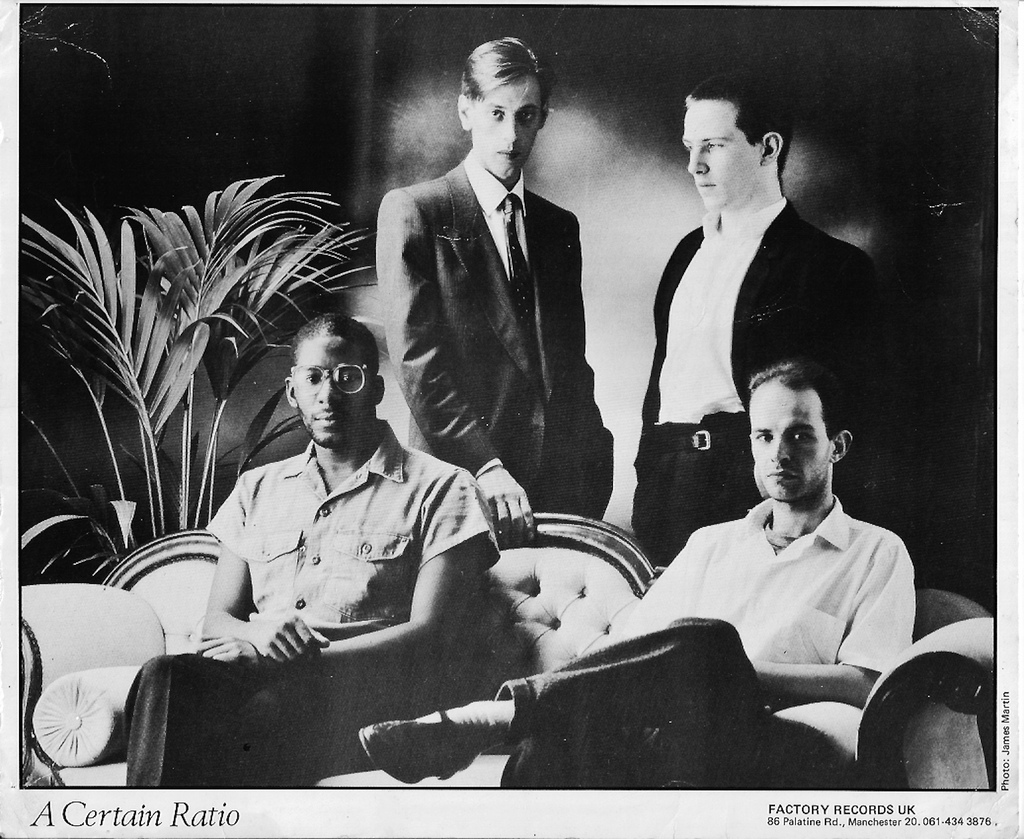
In 1987 a friend made me a compilation tape which included two songs by Mancunian band A Certain Ratio- Shack Up and Do The Du. I've been listening to ACR ever since. They released their latest album, 1982, last Friday and it's fair to say the group have been re- energised in recent years, the result partly of a deal with Mute to re- issue all their albums. I'd been thinking of an ACR Sunday mix for some time and just as I ended up doing a pair of One Dove mixes a while back, I think I may need to come back to ACR for a second go. The mix here contains none of the punk- funk sound of their releases on Factory, the nervous, minimal, scratchy, demob suits and army shorts songs that made their reputation. Instead I've gone for a mix of dancefloor oriented songs spanning three decades. The core trio of Jez Kerr, Martin Moscrop and Donald Johnson have regrouped several times since 1979, not least following the deaths of Rob Gretton in 1999 and singer Denise Johnson in 2020, but they're still creating and producing new music and are getting stronger and stronger. If they're playing near you, go and see them. ACR are a good night out guaranteed.
Dirty Boy came out in 2018 ahead of the group's acr:set compilation, with vocals from Barry Adamson and the sampled voice of one- time mentor, manager and label boss Tony Wilson.
Music Control was a collaboration between ACR's alter ego Sir Horatio and Chris Massey, DJ, producer and promoter from Stretford, a squelchy collision of punk- funk, acid house and mutant disco.
Mello came out in 1992 on Rob Gretton's new label Rob's Records, a slice of loved up Mancunian house.
Be What You Wanna Be is from 1990's acr: mcr, a renewal of the group's sound and fortunes. They left Factory for A&M but 1989's Good Together failed to shift many copies (a shame as it's an album with much going for it). acr: mcr is wall to wall brilliance, from Spirit Dance to Good Together to Tribecca, rhythms and pianos inspired by the records playing in the Hacienda. Personnel changes at A&M saw them leave not long after for Rob's Records. I saw them at Manchester Academy in autumn 1991, a gig packed to the rafters and with a crowd up for it from the moment ACR appeared on stage. A few songs in my then girlfriend decided this was the ideal opportunity to have an argument and walk out of the venue.
Night People was on one of three EPs ACR released in 2021, thirteen tracks, with no filler, following the comeback album Loco, on Mute, from the year before. Night People was on the third of the three, ACR: EPR, and has a swampy Bowie/ Iggy in Berlin groove.
Wedge is by Number, Ali Friend and Rich Thair's spin off from Red Snapper, a 2020 punk funk trip. The two bands swapped remixes, this being ACR's remix of Number. Number's Binary album came out in April 2020 and probably got a little overlooked with everything else that was going on in spring 2020.
Emperor Machine was a collaboration between ACR and Emperor Machine (Andy Meacham, who found fame first time around in Bizarre Inc). The self- titled track was on EPC in 2021 and is supercharged mutant disco/ punk funk.
Taxi Guy is the closing song on 2020's Loco album, an album that showed they were right back on it and fired up. Jazzy, samba grooves and a mass drumming finale. Their vie gigs over the last decade have sometimes finished with the group ending up leaving the stage and walking into the audience, drumming and blowing whistles, as happened at Gorilla in early 2020.
Won't Stop Loving You is a remix of a song from acr: mcr by Bernard Sumner from 1990. Sumner stripped the song back to Jez and Denise's vocals, whipcrack 808 drums and house piano. Something of a desert island disc for me.
A new song from A Certain Ratio appeared on the streaming services last week. It seems the ten songs they recorded and released on Loco, last year's album, weren't the only ones and they have promised three EPs this year. The first fruits of this are Wonderland, a hypnotic, trippy tune with the sadly missed Denise Johnson's vocals out front. Wonderland is a less immediate song that many of the ones on Loco. The woodwind and jazz influences hark back to their work in the mid 80s, the era of Force, Bootsy and Mickey Way, and the funky breakdown and Denise's spoken section suggest some 70s funk and soul going on too but this is definitely new too, an extension of their signature sound. The version on Youtube is three minutes forty- four while the one at Bandcamp is over five minutes long, a device they employed on Loco too- the songs on the vinyl edition were shorter than the extended digital ones. It is, as they say, all good.
Denise Johnson's death in July came as a sudden and sad shock, the voice of so many records over the last three decades and a lovely person too- she was a voice of reason and warmth on Twitter and someone about whom everyone says nice things. It's impossible to imagine Screamadelica, many of ACR's songs since 1990, Hypnotone's Dream Beam or Electronics' Get The Message without her voice on them.
Her solo album was released posthumously in September and sold out immediately (leading to a second pressing). It is only seven songs long, some covers and some of her own songs, done acoustically with her voice at the fore. Three of the covers are of Manchester bands (Denise was a proud Mancunian) and show her roots and love for the songs- New Order's True Faith, Well I Wonder by The Smiths and I'm Not In Love by 10cc. The other cover was this, Sunshine After The Rain, stripped down and personal. Sunshine After The Rain was written and recorded by Ellie Greenwich in 1968, a slightly baroque mod- pop floor filler. The lyrics are classic, post- relationship break up and hoping for better days fayre.
It's probably best known as a cover by Elkie Brooks a 1977 single and as a 1994 pop- rave single for Berri (which also borrowed from I Feel Love). Berri's version may not be great art but it is a highly effective piece of pop music, a song which soundtracks drunken nights out in 90s pub discos, ironing out the heartbreak in favour of hands in the air and fistpumps.
Primal Scream's Don't Fight It, Feel It was one of the songs on Screamdelica that felt truly revolutionary for a group who started as Byrds/ Buffalo Springfield imitators, evolved into a c86 indie band and then reincarnated themselves as leather trousered Stooges rockers. On Don't Fight It, Feel It Andrew Weatherall and Hugo Nicolson made an acid house song and left all traces of the guitar band off it entirely- no guitars, no Throb, not even any of Bobby's singing. Instead Denise Johnson's voice boomed out of the speakers. Weatherall took it all even further on the Scat Mix. Lesser known and heard is the Graham Massey Remix, also from 1991, a juddering Mancunian remix which takes the song into new territory once again, Denise front and centre.
808 State and Massey were on fire around this time. Their 1990 album 90 is one of the best releases from any of the Manchester groups around that time and sounds surprisingly fresh listened to in 2020. Album opener Magical Dream is a real Bagging Area favourite. In June 1990 me, my then girlfriend and my friend Al had my cassette of 90 on all the way from Liverpool to Glastonbury in Al's car. When we pulled into the field to unload our camping kit, it was Magical Dream spooling on the car's stereo. As we got out of the car and opened the boot a mud- encrusted hippy appeared out of a nearby hedge and asked us if we needed any drugs.
There has been a rush of albums released recently (and earlier this year), so many that it's been difficult to keep up- A Certain Ratio, Roisin Murphy, GLOK, Richard Norris, Rickard Javerling, Daniel Avery and Denise Johnson have all been competing for my listening time and I haven't got anywhere near new ones from Bob Mould, Doves and Thurston Moore. Earlier this year Steve Cobby released not one but two new albums and I'm still getting to know them. Andy Bell (Ride and GLOK not Erasure) has an album out at the end of this week. There's the nine track Unloved remix e.p. and umpteen singles and e.ps by a variety of artists. While this year has been grim in so many ways the amount of outstanding new music has been a flood. So, some album reviews to follow this week as I pick my way through the some of the above.
A Certain Ratio's new album, Loco, is a ten song record that is a near perfect summation of all their good qualities. It nods its hat repeatedly to their forty year history and past glories while also sounding fresh and like a band reborn. They kept their hands in with irregular gigging for much of the 21st century but the deal they signed with Mute has freed them from the day jobs and given them the freedom, the time and the space (and presumably the financial security) to write and record. The result is Loco, their first new album since 2008. I posted Yo Yo Gi in August, an 808 and cowbell led house workout, a dance song that takes 1990's Spirit Dance as its starting point and breaks out from there. On side one closer Always In Love Jez's vocals recall the A&M years of Your Blue Eyes and The Big E. Tony Quigley's sax riffs vividly point to the mid 80s funk years of Force. The guitar/ bass/ drums core of Martin Moscrop, Jez Kerr and Donald Johnson keep harking back to the group's past and Denise Johnson voice's adorns four songs, her appearance always a lead vocal more than a backing vocalist, and her tragic passing in between completing the record and its release is sad beyond words. The album's closing song Taxi Guy is a song developed live during the on and off tour they undertook in 2018 and 2019, whistles and drums and funk rhythms, Brazilian percussion and chants, a re-tooled Si Fermir O Grido.
But there's plenty on Loco to suggest ACR aren't stuck in their history- the driving bass and dense electro/ rock of Friends Around Us make for a strong opener, especially after the laid back first half of the song. There is overdriven guitar and funky bass on Supafreak with Factory Floor's Gabe Gurnsey on guest vocal and space age indie disco on Berlin, slightly kraut, slightly Factory but also very 2020. On Get A Grip there's another guest spot, a slinky guest vocal from Sink Ya Teeth's Maria Uzor over dense funk and wigged out synths. ACR were always a group for whom dance rhythms and the groove were primary obsessions, pioneers of what came to be known as punk- funk and still moving forward a decade later when the Hacienda was the centre of the story. This album adds plenty to their story with the gloom and ghostly funk of their early years now updated in vibrant 2020 style.
It was genuinely shocking and so sad to read yesterday afternoon of the sudden death of Denise Johnson. Denise was a feature of the Manchester music scene for the last three decades and her voice is scattered through my record collection, from Hypnotone's Dream Beam in 1990 to singing on Primal Scream's Screamadelica album, especially Don't Fight It, Feel It single, the wondrous Screamadelica song from the 1992 e.p. and the Give Out But Don't Give Up lp (and the recently released original version The Memphis Recordings where her voice really shines), Electronic's 1991 single Get The Message and then the many years she spent singing as a member of A Certain Ratio. Her voice is all over the ACR: MCR album and the Won't Stop Loving You single and it's remixes, all personal favourites. She sings on Ian Brown's Unfinished Monkey Business (the first and best Ian Brown solo album). In 1994 she released a solo single Rays Of The Rising Sun, a song with Johnny Marr on guitars and with an epic thirteen minute remix by The Joy.
In the last few years I've seen Denise sing with ACR on several occasions, at Gorilla (above), in Blackburn, at the university and The Ritz (below). She was always an engaging stage presence, smiling and waving at people in the front row. What's particularly cruel about her passing now is that ACR have a new album ready for release in the autumn and she had very recently announced the imminent release of her debut solo album, a collection of cover versions of songs, just her voice and acoustic guitar.
Her singing with Primal Scream, especially on this song, was a breakthrough for the group. No Bobby Gillespie, no guitars, just Denise's voice and Andrew Weatherall and Hugo Nicolson's production- that juddering rhythm, house pianos and those spacey noises and Denise singing 'rama lama lama fa fa fi/ I'm gonna get high 'til the day I die'. The remix for the 12" was even better and further out than the single mix, her voice chopped up, rejigged and sprinkled throughout the song.
At all their recent gigs A Certain Ratio have finished their set with Shack Up, their cover of Banbarra's funk song, remade in early 80s Manchester as scratchy, punk- funk song. THis clip shows them back in 1990 on MTV, Denise centre stage...
Denise used to live round the corner from us and we were on smiling and saying hello terms but not much more than that. At ACR's gig at The Band On The Wall in 2002 launching their Soul Jazz compilation, the moment when they really began to get recognition for their role and music, she clocked us from the stage and winked and smiled. She was an active and lovely presence on Twitter, always positive and giving her views on politics, football and music. She came across as a genuine, friendly and lovely person. Social media was awash with tributes to Denise yesterday and reactions to the awful news and from people who were close to her and who worked with her. She was spoken of with real warmth and it was clear what she meant to people. She will be hugely missed. I'm sure everyone will join in sending their condolences to her family, friends and bandmates. What a shitty year 2020 has been.
I mentioned the remixes Andrew Weatherall made his name with yesterday. In the early 90s remix culture became the big thing, record companies throwing thousands of pounds at club DJs to stick dance beats underneath a song. Weatherall's remixes never took the easy road, were never formulaic. In most cases the remixes were better than the source material and he was still producing superb remixes until recently.
Primal Scream have put out several Best Of/ Greatest Hits, one only last year. The one they haven't released and would be the contender for the best Best Of would be the one that compiled Weatherall's work for the group. The AW/PS compilation wold start with Loaded, a remix so groundbreaking and gigantic it created an entire scene and gave the Scream a career. Andrew's remix of Come Together is monumental. I once said here that there are days when I think it is the single greatest record ever made and I don't see any reason to argue with myself.
'Today on this programme you will hear gospel and rhythm and blues and jazz. All these are just labels, we know that music is music'
The rest of Screamadelica that Andrew produced would be on this Primal Scream Best Of too- Inner Flight, Shine Like Stars, Don't Fight It Feel It (and the amazing Scat Mix where Denise Johnson's voice is chopped up and scattered over the track) and the Jah Wobble bass of Higher Than The Sun (A Dub Symphony In Two Parts). Then this, ten glorious minutes of slow groove, horn driven spaced out house, from the Dixie Narco e.p.
His knob- twiddling on the other two songs on the Dixie Narco e.p. brought two other classics in the shape of Stone My Soul and their cover of Dennis Wilson's Carry Me Home, one of the very best things Bobby Gillespie and co ever did. Primal Scream's follow up was their Rolling Stones record. Weatherall produced remixes of Jailbird. Trainspotting from Vanishing Point. The far out Two Lone Swordsmen remix of Stuka. The pair of productions he did on Evil Heat- the gliding shimmer of Autobahn 66 and the mutant funk of A Scanner Darkly. Two TLS remixes of Kill All Hippies. Bloods. The ten minute remix of Uptown, a signpost in 2009 that Weatherall was back at the remix peak. The remix and dub version of 2013. The stretched out remix of Goodbye Johnny. That's the Primal Scream Best Of.
In the early 90s his remixes broke genres, chucking in the kitchen sink, its plumbing, the work surface and all the white goods too. His dub remix of Saint Etienne was a moment of clarity for me, the doorway to another world, the two halves glued together by the sample 'the DJ, eases a spliff from his lyrical lips and smilingly orders ''cease!'' '
Andrew's remixes from this period are full of little moments to raise a smile, samples from obscure places, huge basslines, sudden changes in pace or tempo, piano breakdowns and thumping rhythms. Almost every single one is worth seeking out and almost every single one has been posted here at some point. In no particular order- S'Express' Find 'Em, Fool 'Em, Forget 'Em, The Drum by The Impossibles, a mad pair of remixes of Flowered Up's Weekender, the magnificent The World According To... for Sly And Lovechild, his work for One Dove (that produced some career high remixes in the shape of Squire Black Dove Rides Out and the Guitar Paradise version of White Love and his production work on the most beautiful and most lost of the lost albums of the 1990s Morning Dove White), his remix of My Bloody Valentine's Soon, on its own a justification of remix culture and two reworkings of The Orb's Perpetual Dawn that take his and The Orb's dub roots into pounding new places. Roots music.
Add to all these his remixes of Jah Wobble, three versions of Visions Of You, spread over twenty five minutes of vinyl and two remixes of Bomba that have to be heard to be believed. Decades after first hearing this one I found the source of the madcap intro (Miles Davis) when it had been there in the title all along.
His remixes of The Grid's Floatation are also sublime. As a fan of The Stone Roses the moment when he drops John Squire's guitar part from Waterfall into the ending of the track brought things together for me perfectly.
There are so many more. The speaker shattering thump of Fini Tribe's 101. His long tribal workout of Papua New Guinea. The sweet smell of didgeridoo on Galliano's meandering Skunk Funk. The wide eyed mixes of A Man Called Adam's CPI. Indie, ambient, house, dub, everything from the fringes of music's past, ready to sample and plunder to make something new, with a sense of possibility and openness. This would all be mere nostalgia were it not for Weatherall's continual left turns and about turns in the following years. His remixes from the last decade, again almost all posted here at some point, are of a similar high standard but he rarely if ever repeats himself. There are similarities in tone and palette but always with an eye looking forward and perpetual motion. The remix of MBV's Soon and his remix of Fuck Buttons Sweet Love For Planet Earth seem somehow linked to me, the manipulation of noise and the intense melodies found within over crunching dance floor rhythms. I've not even begun to touch on his remixes with Sabres of Paradise, the treasure that lies within Sabres own records (Sabresonic, Haunted Dancehall, Theme, Wilmot, oh man, Wilmot- we were at Cream once waiting for ages for Weatherall to arrive and eventually word came through that he was delayed, wasn't going to make it. Resident DJ and owner Darren Hughes played on and dropped Wilmot, unheard by us at that point, the whole back room skanking to those wandering horns).
Then there was Two Lone Swordsmen whose remixes were harder, purer somehow, more focused, less obvious. It took time sometimes for them to reveal themselves. The TLS albums from The Fifth Mission onward, the stoned hip hop grooves of A Virus With Shoes, the double album of juddering bass and London machine funk of Tiny Reminders, Swimming Not Skimming. My favourite of the TLS albums from this period has become Stay Down. Released on Warp from its cover art, a painting of a pair of deep sea divers, to its memorable song titles (try Hope We Never Surface, Light The Last Flare, Spine Bubbles, Mr Paris' Monsters and As Worldly Pleasures Wave Goodbye for starters- that last one has just made me gulp) it is a self contained mini- masterpiece. Stay Down is an abstract album of short tracks, weird, rhythmic, minimal ambient music, sounding like it has been submerged and then recovered from the deep, humanised analogue IDM. Never standing still, always moving forward.
New Order in the summer of 1987. I was seventeen and was listening to the True Faith single repeatedly that summer, thirty two years ago (Substance, the singles compilation came out in August 1987 too). The band played True Faith on Top Of The Pops and it rose into the top five the week after. They played live, as this clip shows, broadcast recently on BBC4's re-runs of Top Of The Pops. The re-runs are deep into 1987- and it has to be said it was a year of largely terrible music on the nation's favourite chart run down show- most of the episodes can skipped through in minutes with your finger on the fast forward button on the remote control. The week New Order appeared they shared the BBC canteen and dressing rooms with Sinitta and Spagna. This version is, as you'd expect, less sleek and produced than the Stephen Hague single with Hooky's clanging bass more prominent (glorious as the single is) and has a truncated guitar break. I've posted this clip before but watching them the other night I thought it was worth doing again. True Faith is a song I don't get bored of.
True Faith is a New Order tour de force, a single aimed at selling copies in large quantities- earworm keyboards and boom- bash metronomic drumming providing the rush, a song pitched in a sweet spot between pop, indie and dance. Hooky complains in his autobiography Substance that they'd left nowhere for his bass playing in the mix (but he found his way in) and that the only shot of him in the video is his left foot. Bernard was talked into changing a lyric to ensure radio play (altering 'now that we've grown up together/now they're taking drugs with me' to 'now that we've grown up together/ we're not afraid of what we see'). The song feels like a group effort whatever everyone's actual contributions were. I think I read somewhere that Deborah Curtis, Ian's widow, said she couldn't listen to New Order after Ceremony, it was too much following Ian's death, but with True Faith she could listen to them again and enjoy it- which tells you something about the way the song was received and something about the distance travelled from 1980 and Closer to 1987 and True Faith. I love it- partly because at seventeen years old you're so susceptible to these things and partly because it is in some way definitive New Order. It would make it onto any New Order compilation I'd put together.
Peter Saville created a beautiful sleeve, the falling leaf painted gold against the blue background, the leaf idea coming to him as he sat in his car and one fell onto his windscreen. The single was followed by a remix 12" with an alternative Saville sleeve, a remixed version of the song, a different mix of 1963 and also this Shep Pettibone dub.
New Order toured in 1987 too, at home and through the USA (the US leg being the scene of much Hook and Sumner debauchery). The graphic on the tour t-shirt below is very 1987.
Last year Denise Johnson, backing singing extraordinaire, released her own, more emotional reading of the song, done acoustically.
Following yesterday's remix of The Lilac Time here's some more Hypnotone. First that Primal Scream remix (first released as a white label and then as part of the Creation Keeping The Faith compilation, as essential a slice of 1991 as you're going to find). Come Together was/is a masterpiece in its Weatherall ten minute mix and the Terry Farley flipside. Hypnotone's version is more frantic, more bass-in-yer-face, more rave, a more tops off on the podium gurning at the lights kind of tune...
The white label 12" has a lesser known remix of the other side, a more ambient dub mix by BBG (Big Boss Groove, best known for their Snappiness and Some Kind Of Heaven singles, both out in 1990).
Hypnotone were Martin Mittler and Tony Martin. Their 1990 album was recorded at Spirit Studios in Manchester and released on Creation. The vocals on Dream Beam and Potion 90 were by Denise Johnson and led to her getting the gig with Primal Scream and singing on Screamadelica. Dream Beam then gained two remixes of its own, one from Balearic legend Danny Rampling and other, a sparser version by Ben Chapman (both posted here previously). Until fairly recently I didn't know that Dream Beam had a video but here it is in all its dayglo glory...
Hypnotone's album opens with Dream Beam and has the essence of 1990 running through its grooves. Italia is Italian house via Tariff Street M1, house pianos, bouncy bass and a rattling 808. Vocals on this one are by Pauline.
The last track on Hypnotone was Sub, a very nice, end of night, coming down kind of tune with some sublime synths.
Monday's long song today comes courtesy of Primal Scream and the production skills of Andrew Weatherall and Hugo Nicholson. In 1991 the Scream decamped to Ardent Studios, Memphis to chase the muse and record a follow up to Screamadelica. The results were the 12" record released in January 1992, the Dixie-Narco ep, four tracks led by Moving On Up, the desolate blues of Stone My Soul, the achingly gorgeous cover of Dennis Wilson's Carry Me Home and the title track for the album that wasn't actually on the album, a song that was one of the best things they ever did and at 10 minutes 46 seconds, a long song. Screamadelica is glide through the night with Denise Johnson on vocals, 'spaced out, star child, Screamadelica'. Space disco, sampled voices, Leftfield's Paul Daley on percussion, a big bass drum, stretched out sounds, funky horns and guitar, a break down and gear change after four minutes and some robotic vox over a distorted bassline. A band taking flight in the studio. Can you feel your hands, can you feel your feet, can you feel the rhythm?
Here it is played live on The Word, irritatingly only a tantalising 1 minute 12 seconds of it. For a while, despite all the desperate antics, The Word was the only place on TV that had the bands of the moment playing live. I always loved the dancers too, giving it maximum whoever was playing.
And here is some footage from a road movie/documentary that accompanied the Screamadelica VHS release of the videos from the album, with the band and Weatherall, all long hair and leather, wandering round the South.
Two slices of early 1990s dance music to whisk us away from December and all those pre-Christmas irritations. First up is a song I've posted before but only recently saw the video for the first time.
Released by Creation in 1990 Dream Beam is a wonderful slice of house music, bleepy and spaced out with vocals from Denise Johnson. It was this song that got her the gig with Primal Scream and led to her singing on Screamadelica. Tony Martin's production is perfectly in tune with the times- he put an album out too, also called Hypnotone, which is worth pulling out from the shelf or looking out for if this kind of thing is your bag. Dream Beam is also on Creation's definitive 1991 Keeping The Faith compilation, along with Fluke, Weatherall's MBV remix, World Unite, Sheer Taft, Love Corporation, Primal Scream and a couple of others. Keeping The Faith is among the very best things the label ever released.
I saw Hypnotone perform at a mini-festival in Sefton Park, Liverpool (I think it was summer 1990). Larks In The Park was an annual affair starting in the early 80s. Famously in 1985 The Stone Roses and The La's played the same night. Hypnotone went on way after dark. We were on a grass bank across the boating lake from the stage and the bleeps came from the bandstand, drifting across the water towards us, followed by Denise's voice. Everyone was very chilled and happy. It was one of those moments.
I posted Papua New Guinea by Future Sound Of London fairly recently, back at the end of August. August seems like a long time ago now. This is another video I'd never seen before until recently, FSOL playing Papua New Guinea on Top Of The Pops in 1991. And playing it live. Papua New Guinea is one of those records that takes you away from it all.
Weatherall's remix takes things up several gears, a thumping kick drum over that throbbing synths and the rushing rewind sounds. Tom toms. Seagulls. Chanting.
Some songs that are ten minutes long fly by and some feel like they are ten minutes long, a journey to wherever the artist intends to take you. Screamadelica, the title track that wasn't on the album of the same name, was recorded in Memphis with Weatherall and Nicholson at the controls and released on the Dixie Narco ep in 1992. It is ten minutes of blissful Balearic house accompanied by Denise Johnson's vocals- 'spaced out, star child, screamadelica'- and an array of found sounds and other voices. Slip inside.
Denise Johnson, so much more than a backing singer for Primal Scream, the voice of ACR since circa 1990, has a couple of songs on Soundcloud. This one, 2001, has a very cool, after hours Massive Attack feel and is really, really good.
Back in 1994 Denise released a wonderful single, Rays Of The Rising Sun, a lengthy ambient house number. This version remixed by The Joy is a joy.
A couple of lesser known tunes from A Certain Ratio's back catalogue for you today, both real favourites of mine. In 1986 ACR were moving away from the clipped, army shorts, punk-funk of their early years. Force, released in 1986, found them edging towards a more commercial sound. And Then She Smiles is northern jazz/funk/pop but much better than that sounds. Martin Moscrop's clarinet keeps it all slightly discordant (and isn't a million miles from 808 State's Pacific). It's parent album Force was re-issued by LTM back in 2009 and is worth tracking down. I have a cassette copy in one of those cloth-bound boxes Factory went with for a while (Fact 166 fact fans).
In 1987 they signed to A&M and put out several career highs which failed to sell (Good Together, acr:mcr, The Big E, Won't Stop Loving You) and migrated their way back to independence in the early 90s on Rob's Records (Rob Gretton's label). They then released a series of cracking dance/house inspired records including Mello in 1992. Mello came in a variety of versions, including M-People remixes and dubs.Part 1 was the radio friendly one. The 303 Dub is great too. Mello (Part 1)
Released twenty five years ago this month Primal Scream's fourth Screamadelica single was Don't Fight It, Feel It. Where Loaded had been one of the key indie-dance triggers and Come Together was Weatherall's gospel masterstroke and Higher Than The Sun was just so far out and gone, Don't Fight It, Feel It was pretty much the closest they came to making house music (maybe Slip Inside This House shares that). DFIFI is wobbly house but house music nonetheless with a shuddering bassline, Denise Johnson's wonderful vocals and bleeps and bloops and all manner of dancefloor sounds. The various single versions came with remixes including the even housier and barnstorming Scat Mix where Weatherall and Hugo Nicholson twist their own track inside out and upside down.
The song and others on Screamadelica caused ructions in the group no matter what Bobby told the press, guitarists walking out of studio sessions and people's egos threatened by not being on certain tracks. They worked it all out for the live shows. This TV appearance on The Late Show shows how they got a guitar-led version of DFIFI going, with Throb working his way around house music on a Les Paul and Bobby sharing the vocals with Denise. Good stuff. And unlike The Stone Roses, they didn't blow the sound meter and then shout abuse at Tracy McLeod.
I was listening to Primal Scream's Give Out But Don't Give Up recently. I saw it in a charity shop for 50p on cd and bought it. It's handy to have vinyl lps in a digital format sometimes, if nothing else for listening to in the car. It took me quite a while to get around to buying it when it came out in 1994. As a follow up to Screamadelica it seemed so retrogressive and while I'd bought and loved the Rocks single it just didn't yell 'buy me' at me in 1994. At the time the press labelled the band Dance Traitors and listening to it now it is difficult to disagree except that in hindsight Screamadelica is the odd one out really. Given the extensive touring the band were doing, the drug intake and the opportunities they were presented with it's probably no surprise they indulged themselves with every rock cliche imaginable. From the William Egglestone Old Glory cover onwards this is early 70s US rock, in velvet trousers, snakeskin shoes and silk scarves. The two openers Jailbird and Rocks are both fine Stonesy rockers, good dirty fun with big Throb riffs. The ballads are all ok too but there are too many of them and crucially none of them are as good as Screamadelica's Damaged. To these ears the only two songs that really move things forward are the ones done with George Clinton- Funky Jam and the title track. Funky Jam is exactly what it says it is but has got some clout. Give Out But Don't Give Up is marvelous- sultry, woozy, head spinning funk with lovely vocals from Denise Johnson, dirty guitars and Clinton's atomic touch.
Having said this, criticisms and all, I enjoyed listening to it. It sounded better now than it did back then, twenty one years ago. The question that then struck me was, bearing in mind the somewhat parallel late 80s and early 90s careers of Primal Scream and The Stone Roses, is it better than The Second Coming?
I'm going to see A Certain Ratio tonight, Manchester's perennial nearly men and women. I've seen them several times live and they're always good. I thought I'd post up some live clips to see me on my way out.
This one is ACR live on Granada TV, New Year's Eve 1991, playing 27 Forever and Mello. Personally I love the house music ACR (Good Together, the whole MCR album, The Big E, Won't Stop Loving You, 27 Forever and Mello) as much if not more than the early 80s Factory Records punk-funk incarnation. I imagine Tony Wilson made this appearance happen.
From a year earlier, live at London's Town and Country Club. I don't know where Denise is- tied up with Primal Scream maybe.
And this is an unplugged version of Won't Stop Loving You, done much more recently.
London Lee supplied a link to this via Twitter the other day. It is very funky. A Youtube commenter has cast doubt on whether the 70s Soul Train audience are actually dancing to Banbarra's Shack Up or another song entirely but, y'know, whatever.
Shack Up is best known in these parts as an A Certain Ratio song. It's a cover obviously. There was an ACR singles compilation with the Shack Up 7" in a sleeve glued to the front of the album (The Old And The New, Fac 135, from 1986, which is where I have it from). It was also released as a single on Factory Benelux- bet you're glad I'm here to clear these things up aren't you? Singer Simon Topping left the band in 1983 to join Mike Pickering in Quando Quango. He went off singing, much to Tony Wilson's annoyance. Like Joy Division but better dressed, according to 'Tony' in the film Twenty Four Hour Party People.
There's a tense northern whiteness to ACR's version.
By 1990 ACR had left Factory and were in danger of crossing over (they didn't). Their MCR album is a house influenced beauty. Here they perform Shack Up for MTV with Denise Johnson on vocals. Martin Moscrop's guitar work is particularly good.